Category: Self Care

  • Self-Medicating as I Age

    No system is perfect; they all have the vices associated with their virtues. The profit motive drives much of our medical system, but it can ignore things that show no profit possibilities. Also, much of our medical system is driven by life and death outcomes. So things that are just uncomfortable or inconvenient are frequently ignored. As I age I find that I need to provide more of my own medical care as my body’s changes are just not important enough to involve others.

    This is my list of conditions where I am all or part self-medicating:

    • Blood condition precursor to Chronic Myeloid Leukemia (CML)
    • Osteoarthritis
    • Supraventricular Tachycardia (SVT)
    • Too much trouble finding the right word
    • Premature Ventricular Contraction (PVC)
    • Aggravation with politics

    This is my list of solutions to those things (in the same order):

    • Low Dose Naltrexone (LDN)
    • Glycine (an amino acid)
    • Taurine (an amino acid)
    • Acetyl l-Carnitine (an amino acid)
    • Hawthorne Extract and D-Ribose
    • Lithium Orotate

    Low Dose Naltrexone – In my 60’s I was diagnosed with a blood condition precursor to Chronic Myeloid Leukemia (CML)L. I was told “It will probably develop, but don’t worry. We can treat it.” Of course I worried; it was the first big medical thing that had happened to me since I was 5, when I had polio (when my parents worried). One of the places I took my worry was to a friend, an inventor specializing in medical things. He told me to take a look at LDN. I looked it up on line and found ldninfo.org. I read the whole site, printed out a dozen of the pages, and took them to our GP – who actually read them. His conclusion was the same as mine: “It doesn’t cost much and is unlikely to cause harm if it doesn’t work.” He wrote the prescription. A year or two later I no longer had the condition. The blood guy (a/k/a hematologist) said “Spontaneous remission.” I tried to tell him what I’d done but he wasn’t interested.

    Naltrexone was developed to counteract opioids; it blocks their effects. The standard therapeutic dose is 50mg every 8 hours. The standard LDN dose is 4.5mg, once daily at bedtime.

    A few years later my wife, Paula, was diagnosed with fibromyalgia; the initial prescription did little. So she began the effort to have her doctor prescribe LDN; it was a long effort, but she eventually succeeded. It somewhat worked: she describes it as 90% effective, and effective enough. A few years later it stopped working. The compounding pharmacist suggested trying one or more 0.5mg capsules with the 4.5gm capsule. One was enough, 5mg was her new dose.

    I’ve kept taking and reading about LDN. A couple of years ago I found the LDN Research Trust, which is even more comprehensive than the LDNinfo site. It helps you find someone to write a prescription and pointed me to a company that makes LDN in pill form, which should be cheaper and more reliable.

    Glycine – In my 50’s I was diagnosed with osteoarthritis and told to take naproxen; I did so for a year or so. And then decided that I didn’t want to take a daily pain killer. I though of a friend that I co-drove with at Daytona in the early days of IMSA; he was 70 at the time (ancient in my eyes then). We had little money so we shared a room. In the morning he worked every joint in his body, “to keep them working,” he said. He finally quit driving race cars because it was interfering with his tennis. Anyhow, I stopped taking naproxen and started daily exercise. I still had a little joint pain, but I’ve kept exercising, and learned to like it.

    About 15 years ago I bumped into Steve Gibson’s efforts to fix his sleep. He was waking at 1am and staying awake until 3 or 4. I was nothing like that, but I thought I could sleep better. I tried his vitamin concoction and convinced myself that I was sleeping better. Probably not. But as his approach evolved, I kept up. Along the way I began adding powdered glycine to my drinking water. And the very minor joint pain I had went away. It makes the water taste a little sweet, and if I take too much I produce some really bad smells. But I’ve learned how much to add to my water to get my benefits without bothering others. For me, it’s about 1/2 teaspoon per liter of water.

    Note on amino acids: Among other things, they are the building blocks of protein and they have received a lot of study. However, most of the studies are on fruit flies and rodents. So the results are only suggestive. My experience with glycine made me aware of the hypothesis that age can reduce the body’s ability to extract needed amino acids from proteins. So I became more willing to try amino acids. They are cheap, easily obtained, and unlikely to cause damage.

    Taurine – One night in my 60’s I woke up with a racing heart; it was over 200. I woke up Paula, and she took me to a hospital emergency room. I was seen quickly, and they gave me a shot that stopped my heart temporarily (not a good thought!), and it was normal when it restarted. They told me I had SVT and I visited a cardiologist for the first time. She was impressive. She explained that it was a miswiring of my heart nerves and that it could happen again. She prescribed a pill to carry with me and to take if/when it occurred again and showed my how to do stomach crunches, which could stop an episode by itself. She said that if it happened too often there were other things that could be done, but I didn’t like them. So I lived with it, as many others do.

    I first read about Taurine on Steve Gibson’s news site. In his article about Taurine, an amino acid, he commented that it tends to stabilize heart function. Well, my SVT could benefit from some stabilizing, I was having an episode every 2-3 months. I started taking a gram of Taurine twice a day, SVT frequency dropped to 3-4 months. I was diagnosed with sleep apnea and started using a CPAP machine, SVT frequency dropped to 4-5 months. I increased dosage to 2 grams twice a day, and it’s now been more than 3 years without an SVT episode. I tried 3 grams twice a day for a while but returned to 2 grams twice a day when standing quickly frequently caused dizziness from my blood pressure dropping too much. (This was also associated with my trying Hawthorne extract, below.)

    Acetyl l-Carnitine HCI – I’ve been discussing Creatine with my son for several months. He and my grandson are taking it to improve athletic performance. I read some articles, but wasn’t convinced. (In my 80s I don’t care about improving my athletic performance.) Then I read an article in the Life Extension Magazine about it. What most intrigued me was the summary of Carnitine effects: “Carnitine intake boosted mental and physical energy levels, reduced mental and physical fatigue, enhanced cognitive and neurological function, and improved frailty scores.”

    This sounded good. I ordered some and tried it, taking 1gm after breakfast and dinner. After a week I realized that I wasn’t unable to find the right word any more. This had been a growing problem for me, it was noticeable enough that Paula encouraged me to see a neurologist. I did, and after tests he said it was just aging – but to come back in a year for a comparison. So the Carnitine (a/k/a ALKAR) fixed a real problem for me, without my expecting it to do so! (BTW, this occurred about 10 months after I last saw my neurologist; when I saw him he accepted the effects on me and told me he would investigate it further for others’ potential benefit.)

    Then I went skiing. In the past when someone lifted the ski lift’s safety bar too early I would have a pang of fear, and I would grab something. (I always sat on the outside so there was something to grab.) Now, no pang! I just said to myself “Oh, the bar is up already,” without any other reaction. Two days later we went to Newport, RI for dinner, to our favorite restaurant. The Newport Bridge is high, narrow, subject to winds, and you can see through the sides. Normally, I turn on the radio or a book to concentrate on as I drive white-knuckled across the bridge. This time, just minor fear! No white knuckles! Just high winds and a mostly comfortable drive across with hands relaxed. A little fear, but not important; I could do what I wanted! Two good, unanticipated effects of ALCAR – “unanticipated” to me indicates that I couldn’t have made up the effects. I’m taking 1gm after both breakfast and dinner.

    Finally, I’m impressed with this article about it. It taught me that the acetyl form can pass the blood/brain barrier, making it most useful for me and that its half life is almost 36 hours. Other reading taught me that the HCL form indicates its a salt, and easier to dissolve.

    After a couple of months the ALKAR wasn’t working as well. When I looked at what I was taking I realized that I had halved my dose. When I switched to 180 capsule bottles I inadvertently switched to 500 mg capsules; when I thought I was taking 2 grams I was taking one. So I first increased to 1.5 gm in the morning and 1 in the evening; my symptom, dizziness when I moved quickly, declined. After 10 days I increased my dose to 2 gm morning and evening. As I didn’t keep proper records, this is probably what I was taking when finding the good results.

    Hawthorne Extract and D-Ribose – Premature Ventricular Contracton (PVC) is a partial contraction before an effective heart muscle contraction. By itself, it’s primarily a waste of energy and, if you have limited heart strength it can affect what you can do. Also, some people are aware of it occurring and are bothered by it. I’m lucky: I like to exercise and do so, so my heart is in good shape. And I don’t notice the PVC events.

    When it was noticed before a cataract replacement procedure my cardiologist evaluated mine. My PVC episode occurred on 26% of my heart beats, based on a 24-hour sample. 10% is typically considered the check-it-out level, so I saw an electrocardiologist. He found that the PVC event locations are diffuse, so that ablation would have little effect. But since I exercise a lot and don’t notice the PVC’s I can ignore them.

    The material below on PVCs is essentially obsolete for me. When I was at Dana Farber for a planned visit they detected a heart rate of 37 – too low! However, it’s uncertain whether their measure was confused by my PVCs or was real. Also, their EKG showed continued PVCs. I was only taking Hawthorne extract, but I also was experiencing brief (half-second) feelings of vertigo. So I’ve stopped the Hawthorne extract. Another Holter monitor (scheduled for 12/4) will tell me more. In the week after dropping the Hawthorne extract I’ve had no brief vertigo events.

    That was good news, but I wanted to try to reduce the PVC frequency, so I read a bunch of opinions and some research. I found that three things were generally recommended: (1) Hawthorne extract; (2) D-Ribose, a building block of ATP; and, (3) l-Arginine, an amino acid. I cycled through them individually and in combination, evaluating their effectiveness for me with the number of extra minutes of exercise detected by my Fitbit. For me, this was least with 600 mg of Hawthorne extract twice a day plus 850 mg of D-Ribose twice a day. l-Arginine had the least effect on me. I choose a brand of Hawthorne extract that was standardized so I’d always take the same amount.

    To the extent that I can measure the effects, I think that I have reduced the frequency of my PVC’s. But I won’t know until I see a cardiologist again, and it will probably be a year before I can be monitored again. Regardless, I’ll post here when I know more.

    Since I wrote the above I looked at D-Ribose’s half life, about 15 min, so it just won’t last long enough to affect many PVC’s. It may have a good effect on declining heart function (link), but happily I’m not currently facing that. So I’m going to try discontinue taking it. As I still have some maybe I’ll take some on skiing days to see if it helps.

    Lithium Orotate – I subscribe to and read the Life Extension Magazine every month. Overall, I’m not impressed with most vitamin research; the sample sizes are too small and they pay too little attention to confounding effects. But the LE Mag tries, and I accept many of their results. They mostly pass my lower bound “it can’t hurt, it might help, and it’s not expensive” test. One of their reported studies indicated that 1mg of Lithium Orotate daily might reduce the likelihood of dementia. So I began taking it, didn’t expect any changes and found none.

    Over the next couple of years politics became more unpleasant, which bothered me. So I read more about Lithium Orotate and thought that increasing my dose to 5mg might reduce the bother. It tried it, and it did. So I now take 5mg of Lithium Orotate daily; I think of it as my political vitamin.

    Recently I received a Ground Truths email from Eric Topol (I look forward to these as I find them well written and documented). This one was titled “Lithium and Its Potential Protection from Alzheimer’s Disease“. This article lived up to my high expectations and gave me another reason to take Lithium Orotate, although I’m long past the age when it has its greatest effect on Alzheimer’s.

    Last edited 11/9/2025

  • Breakfast

    Breakfast

    Breakfast means breakfast cereal to me. I eat the same breakfast for many years. It began when I was a teenager: Cheerios during the week, a dusty sundae on Saturday (vanilla ice cream, chocolate sauce, with powdered malt on top); and waffles with maple syrup on Sunday.

    I know this isn’t the right place for it, but I have to write about chocolate syrup. When I was a teenager it was always Hershey’s, and I kept using it for decades until I talked with Rita. She was from New York City, and said that Fox’s u-bet was better. I didn’t believe her and insisted on a blind taste test – she was right! In comparison, Fox’s has a better taste that was just chocolate. I now dislike and avoid Hershey’s.

    Cheerios

    This was my first long-term cereal, begun in my teens and lasting for decades. Unfortunately, I wasn’t happy with generic or any knockoff I could find. It had to be the brand name and I’d go though two of the largest boxes a week. My process: fill the bowl with cheerios, add milk until some cheerios fell out of the bowl, place the escapees carefully on top, and carry it carefully to the table. Looking back now, it was boring – but I’m happy with boring breakfasts. Paula, in contrast, has to have something different every day. Eventually, due to its sugar content, cheerios was replaced by shredded wheat.

    Shredded wheat

    About the time I became interested in vitamins (see my vitamin post) I became aware of the sugar content in cheerios. Shredded wheat was its replacement. For this, the different brands were less important to me as I found something to like in most of them. Also, as the cereal was denser, I didn’t fill the bowl as full as I could.

    Vermont Visits

    When I visited my grandfather in Vermont we always had cooked cereal for breakfast. (By the time I was visiting my grandfather by myself we had lost my grandmother.) We cycled between Maypo, Wheatena, oatmeal, and something else I can’t remember. Sundays were waffles with maple syrup.

    We always have Vermont maple syrup on hand. My grandparents retired there and they sent us a gallon twice a year while I was growing up – even when we were on Guam. Since I’ve grown up I don’t use as much, but we always have it in the fridge (it lasts longer there) or in the freezer (it lasts forever there). Our favorite is a dark grade with intense flavor without being bitter. We have more than a gallon left from 2014, the last time we found it. At the rate we’re using it we may have it for the rest of our lives – at least we hope so. Finding that kind of syrup is luck, it happens randomly and rarely. My friend Orville made some, and we split what he had left with my cousin Nate. As he has four kids, I expect his is gone – and that he will be jealous when he reads this.

    The Cereal Bowl

    While I was attending HBS (see my Harvard Business School Doctorate post) I bought a new cereal bowl. Normally, this wouldn’t be something to mention, but it turned into a production. I had wandered into a store with many bowls and decided that I needed a new one – but it was $5! I know it isn’t that much, but I had furnished my entire kitchen for $3.50 at Tom’s Swap Shop in Ohio. Somehow, it didn’t seem right to spend 40% more on a single bowl. But I liked it; it had just the right curve and was just the right size – so, eventually (it might have been two hours), I bought it. And I’m still complaining about it. Sometime in the early 2000s it cracked, but I kept using it.

    When we were driving near the Sugarbush Ski Area in Vermont, Paula and I stopped in a pottery shop. There we found some purple pottery that appealed to us, serving pieces and bowls. I looked closely at the bowls and decided that some of them would be acceptable as a replacement for my cracked bowl. I think we bought eight bowls; we now have four – of which two are acceptable cereal bowls. The others work for ice cream, for example, but I dislike them for cereal. Their curve just isn’t right. I’m hoping the two remaining bowls will last. I look for cereal bowls occasionally, but I haven’t seen another acceptable one in years.

    Muesli

    My sister ate muesli frequently. She had spent years teaching in Germany, and continued to eat muesli when she returned. I tried it several times when we were together, but it always seemed too sweet to me. After we moved to Cranston, Rhode Island (where we now live), I started looking for a muesli that I liked. After trying all of the box brands that I could find I tried one from a bin in Whole Foods – and I liked it. It had enough components that the bites varied in taste and texture, and it wasn’t too sweet. (Paula said it was too sweet, but I was OK with it. Also I sprinkle a cc of green tea extract on it, which cuts the sweetness. See my Vitamin post.) Luckily, the label had the maker’s name printed on it as Whole Foods stopped stocking it. So I ordered it direct from the company, Grandy Oats. I ordered two three-pound bags at a time for a decade. I came to like doing it that way as it was fresher. Then, they stopped selling it in three-pound bags, so I ordered a larger bag. When it arrived – thin plastic, not resealable – I was irritated. I wrote to the company and complained. They, very politely, said “Sorry, that’s the way it is. But you can now buy it at Whole Foods.” But I liked the freshness, and I didn’t like the change. So I started looking again. (Whole Foods stopped using bins because of the coronavirus so Grandy Oats began selling three-pound bags again, but it was too late to get me back.)

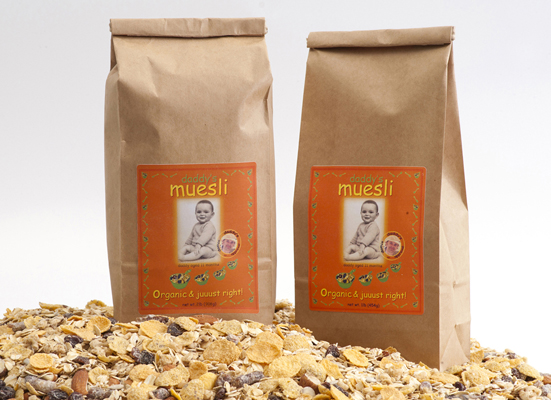
    Daddy’s Muesli

    I’d learned from Grandy Oats’ muesli that I liked a variety of components in my cereal. I searched. I tried Bob’s Red Mill muesli, but it was too plain. Eventually, I found Daddy’s Organic Muesli on Amazon, among several others that I wanted to try. Daddy’s was the best for my taste. I’d ordered a pound to try it, so I ordered five pounds and worked to eat up the others. It came in a non-resealable (but thick) plastic bag, so I accepted the packaging. In the early days of the coronavirus I looked at Daddy’s web site and found that they were in Sri Lanka. As I didn’t want to run out I ordered the 15 pound pack. It came in a resealable, thick plastic bag in the largest USPS flat rate box – it just fit! While I’m still using up the last of my Grandy Oats muesli (20% with 80% Daddy’s), my cereal has never tasted better. I’m almost ready to order another ten pounds; it’s expensive per pound, but this quantity is the cheapest per pound. It lasts a long time and I’ve never tasted a better muesli. My breakfast rut is now very comfortable; I’m happy.

    Fruit

    When we have suitable fruit I add it to my cereal. But I can’t find good tasting fruit for much of the year, so I thought of dried fruit. In trying other cereals I learned that I like the taste of cranberrys in cereal. That sort of tang was the one thing I thought that Daddy’s was lacking. So I looked for a supplier. While I like craisens – particularly their texture, like raisins – they have too much sugar for my taste. So I looked for unsweetened, dried cranberrys and found Cherry Bay Orchards. I like their taste, but they are more difficult to chew than the rest of my cereal. Trying to find the same effect without the hard chewing, I tried some unsweetened dried tart cherries and liked them. I’ll update this with my opinion when I have one – including about freeze dried fruit.

    Four months later: For the added fruit I’ve settled on dried tart cherries; however, the only unsweetened one I’ve found is Sareks (link) on Amazon. While some others are advertised as unsweetened when I read the fine print I found that they added artificial sweetener and/or oil — neither needed by me. Occasionally I add a few whole freeze dried cranberries. While these float on the top they give a nice burst of flavor and tartness.

    Freeze Dried Fruit

    As I don’t write about cooking – that’s Paula’s department – I don’t know where else to put this, and the subject deserves mention. I’ve tried several freeze dried fruits from North Bay Trading Co. While I haven’t tried them in cereal yet, my recent reading of comments makes me want to. I keep freeze dried bananas and pineapple near my exercise equipment because occasionally I have a blood sugar crash. So I eat a couple of handfuls and drink some water, and it goes away. I found the company through their 32 Bean and 8 Vegetable Soup. It’s far and away the best bean soup I’ve tried; I thought I didn’t like lima beans but their giant Christmas limas changed my mind. I’ve ordered some other freeze dried fruit to try with cereal, and I’ll update this when I have an opinion.

    August 16, 2020, January 3, 2020

  • My Experiences With Vitamins

    I began thinking about vitamins after I quit smoking in my late 20s. (I was sick and away from home – and decided that I wouldn’t feel much worse, so I quit.) This new interest in health led me to look for information on vitamins – and I found Adele Davis. I found, bought, read and reread all of her books; in addition to general information I found an important generality: Individual need for a particular vitamin can vary over a 1000:1 range.

    A decade later I had a friend who was working towards a PhD in Nutrition at Harvard. I picked her brain as often and intensely as politeness allowed. She debunked some of what I “knew”, but gave me another important generality: “We know a lot about what the average person needs, but almost nothing about individuals.” This was consistent with the earlier generality and confirmed me in my try-it-and-see approach. So I’ve taken vitamins for two reasons: To help solve a particular problem, and to help with general health. I can evaluate the effectiveness of the first by listening to my body, but the second should – and mostly does – depend on science.

    Vitamin Sources

    For the first decade or so, I purchased my vitamins from health food stores – where I could read the labels and chat with (presumably) knowledgeable people. This seems a good place to mention one of my father’s favorite self-descriptions: “Often in error but never in doubt.” (Which applies equally to me.) Obviously, I would be susceptible to this with the people in the stores – but the books I purchased there generally gave additional credence, perhaps because they read them too. After mail-order catalogs became common, I browsed these for additional ideas and sources.

    After the Internet became available I used its information and availability. For the “general principles” part of my vitamins I tried to find companies the frequently modified their formulas in accordance of research results. While several said they did this, none of them were long-term successful, so I had to find a new company every few years. Eventually, I stumbled on Life Extension Foundation, which has supplied most of my “general principles” vitamins since. While I order from them, I also check their prices on Amazon as it is frequently lower. For non-LEF products I also check iHerb.

    Vitamin C

    One of the major assertions of the Adele Davis books, later repeated and amplified by Linus Pauling is an emphasis on vitamin C. So I took a lot of it for many years, generally as powder dissolved in water. As it was an acid – ascorbic acid – over time it dissolved some of the outer surface of my front teeth. When I finally noticed this I stopped using the powder. More recently, I became aware of ascorbates – vitamin C with a mineral, calcium for me, dissolved in water. This isn’t acidic, so doesn’t further dissolve my teeth, and doesn’t affect my digestion as the acid did.

    Did I notice any difference with vitamin C? Yes, two: First, when I visited friends in Ohio who lived near a grain mill I wasn’t sneezing all the time. Second, my frequency of sinus troubles declined. So it wasn’t just general principles for me, my conclusion was that I needed more vitamin C than the average and I’ve continued to provide it.

    Blood Sugar

    When both I and my sister were old enough to drink we noticed a pattern: When our family went out to dinner, my mother, sister, and I were all in bad moods until we had a few swallows of wine or a drink – then we were fine. We discussed it and concluded that we all had low blood sugar because dinner was later than usual. As we became aware of it we learned to resist the effects, making these events more pleasant for my father.

    After I was diagnosed with prostate cancer I again started reading. At the Life Extension Foundation web site I found some studies relating cancer growth and metastasis to blood sugar spikes. They hypothesized that some cancers needed this to grow. As a roundabout way to test that hypothesis they looked at cancer incidences in diabetics taking metformin – and found that many cancers had lower incidences. Metformin is widely used to prevent the blood sugar spikes that do diabetics so much harm. So, I asked my doctor to prescribe it and took it for several years. No surprise, my problems with low blood sugar went away. However, eventually the side effects led me to look for something else.

    I found berberine, which was anecdotally reported to have the same blood sugar effects as metformin, but without the side effects.

    Anecdotal reports digression: I tentatively accept and act on anecdotal reports if (1) no one is making excessive profits from it (making a living is OK, buying a jet is not); and, (2) the effects if I’m wrong to try it are minimal.

    Berberine met these tests, so I tried some. I bought it as a powder – with capsule loading equipment, as I wanted to try loading my own capsules. I was immediately banished to the basement as the berberine was bright yellow and would stain the kitchen counters. This was inconvenient, so I bought capsules after I used up the powder. It didn’t work as well as metformin for me, but I’ve continued taking it because of its reported other benefits. It’s not expensive, but after writing this I plan to stop taking it for a while and see if I notice a difference. Months later: I didn’t see a difference, so I’m no longer taking it.

    Low Dose Naltrexone

    Generally know as Low Dose Naltrexone (LDN), it is a drug, not a vitamin, but I think of it more as a vitamin so I’ll discuss it here. It was suggested to me by a medically-knowledgeable friend who is not a doctor. He first suggested it for another friend who has Machado-Joseph Disease, with effects similar to ALS. Before suggesting it to that friend, I read all the material available on the Internet. While that second friend wasn’t comfortable asking his doctor for it, I didn’t forget it – as it entirely meets my position on anecdotal reports.

    When I was diagnosed with a precancerous blood condition I asked my doctor to prescribe it. After a few years that condition disappeared, which I attribute to the LDN – my hematologist didn’t agree, he called it spontaneous. When Paula was diagnosed with fibroymyalgia she asked her doctor if she could try it; it’s 80-90% effective for her. And she can test it: 2-3 weeks after she stops taking it she can’t walk downstairs normally; then, 2-3 weeks after she resumes, she can do so. I continue to take it for prostate cancer, and general health. (There is also the possibility that LDN’s effect on autoimmune conditions might prevent the cytokine storm sometimes found with Covid-19.)

    LDN is a single pill taken at bedtime. It removes the beta-endorphins from the blood; then, about 3am, when the body makes them it recognizes the scarcity and makes more than usual – resulting in more available. Thus, it’s a direct effect on the immune system. That’s why the list of things that it is considered useful for is so long. The cost of manually compounding the capsules is essentially all of its cost. As naltrexone is commercially available in 50mg tablets; these are crushed to provide the (typical) 4.5mg LDN capsules.

    Taurine

    I first encountered taurine in Steve Gibson’s first healthy sleep article. Gibson gives a weekly podcast on computer security and sells a program for fixing broken hard disks. He was experiencing difficulty sleeping and – characteristically – exhaustively researched what might fix it. His write-up and references on taurine hit a chord with me. I had been experiencing SVT, a rapid heart rate due to miswiring of some of my heart’s nerves. While I could take a drug when it occurred, I wanted to avoid doing so. I tried 2 grams of taurine twice a day and the episodes declined from every-week-or-two to every-month-or-two – a clear improvement, so I’ve continued it. (BTW, since I’ve used a CPAP machine and increased dosage to 3 grams twice a day it’s been two years since I’ve had an episode.)

    Vitamins D3, K2 Mk7, Calcium, & Magnesium

    It was Steve Gibson, again, that raised my awareness of Vitamin D when he devoted a computer security podcast to it. It had been included in my multivitamins for decades, but Gibson’s write-up and references brought new information. So I increased my intake – and my doctor added a test for my levels to my annual blood test. Additionally, I made sure that any changes in how much I’m taking happens a couple of months before a blood test so I could ensure I wasn’t taking too much. (I’m not in the sun much and I live in New England, so I get little naturally in spite of my excessively light skin.)

    One of the outcomes of my prostate cancer was osteoporosis – a good trade, in my opinion. So, in addition to a non-Newtonian back pad for skiing, I’ve tried to encourage my body to reverse it. While my readings on the subject were not encouraging, I wanted to do everything I could. So, I increased the amount of D3 and added Vitamin K2 Mk7, calcium, and magnesium. The calcium was mostly in a product from Life Extension Foundation plus some more at bedtime. Some magnesium is included in the LEF product, but I take some more at bedtime (another Steve Gibson recommendation).

    Another bone density test is scheduled in three months, so I’ll find out the results then.

    Omega-3 Fish Oil

    One of my repeating discussions with my doctor is triglycerides – they are too high – this isn’t surprising with my love of ice cream. I mentioned this to my cardiologist (yes, I have one of those too), who recommended omega-3 fish oil. I looked at some of the many offerings and settled on one, and my doctor has been happy with my triglycerides since. Success.

    Curcumin

    Curcumin has good and well-documented effects on depression, inflammation, pain, symptoms of osteoarthritis, anxiety, and others. While not all of these are relevant to me, many of them are. There are anecdotal reports of it reducing myelopathy – which I have due to osteoporosis. It effects me in certain positions – which I’ve learned to avoid – but it seems to be less since I’ve been taking curcumin.

    Glycine

    This came out of discussions on Steve Gibson’s h.tns newsgroup, which was originally purposed for the sleep-benefiting effects of electricity through the brain and has moved on to magnetism. One of the results of his and others’ tests is that glycine boosts and/or enables the effect for many. For some it appears to work without other stimulation. I found that my number of sleep apneas declined when I took glycine at at bedtime. While some have reported stomach problems with it, I haven’t and plan to continue it.

    Cholesterol

    The other repeating discussion with my doctor is cholesterol, he’s happy with my HDL but not with my LDL. In the past, I tried his recommendation of red rice yeast (after reading about it). But it didn’t suit me – I felt weird – and I stopped taking it. Also, I don’t like what I’ve read about statins; I’d feel guilty about refusing to take them, but I probably would refuse anyway. Some of the vitamins I’m taking are supposed to help, but they obviously aren’t helping enough. I exercise fairly strongly because I like exercise and doing more isn’t reasonable. So, I did some looking around on line, and found two suggestions: policosanal and guggulsterone. These are cheap with few reported side effects, and I plan to take one per day each through my next blood test to see if they help. Since this makes three new vitamins (with quercetin) for LDL, if it drops I may experiment to see if all are needed if the experiment is successful.

    Green Tea

    Having read that green tea seemed to reduce the likelihood of metastasis, I realized that I didn’t much like drinking tea. So I looked for alternatives. I found green tea extract in capsules and powder – the powder was described as bitter-tasting. This seemed to be a good combination with slightly-too-sweet breakfast cereal. As I was impressed with LiftMode because of their apparent high quality and unusual substances I decided to try theirs — which was 300 grams, a 600 day supply. I’ve reordered it once and will do so again in a few months.

    General Principles

    Ubiquinol and LEF’s 2-capsule multivitamins are my general principles vitamins. Ubiquinol is one of those recommended by Steve Gibson, whose obsessiveness I trust. (There was a recent discussion about it on his health newsgroup that clarified some points for me.) Likewise, LEF’s multivitamins meet my objective of being periodically updated to reflect research results.

    Conclusions

    I am aware that my belief and implementation of vitamins puts me on the lunatic fringe for some. My defense is the two generalities I mentioned at the beginning of this post: People vary greatly in their need for and response to vitamins. Also, learning about and using them helps me feel that I’m contributing to my health.

    July 11, 2020; July 28, 2020 added green tea section; March 2025 removed some no longer taking