Author: transi58_wp

  • My Experiences With Vitamins

    I began thinking about vitamins after I quit smoking in my late 20s. (I was sick and away from home – and decided that I wouldn’t feel much worse, so I quit.) This new interest in health led me to look for information on vitamins – and I found Adele Davis. I found, bought, read and reread all of her books; in addition to general information I found an important generality: Individual need for a particular vitamin can vary over a 1000:1 range.

    A decade later I had a friend who was working towards a PhD in Nutrition at Harvard. I picked her brain as often and intensely as politeness allowed. She debunked some of what I “knew”, but gave me another important generality: “We know a lot about what the average person needs, but almost nothing about individuals.” This was consistent with the earlier generality and confirmed me in my try-it-and-see approach. So I’ve taken vitamins for two reasons: To help solve a particular problem, and to help with general health. I can evaluate the effectiveness of the first by listening to my body, but the second should – and mostly does – depend on science.

    Vitamin Sources

    For the first decade or so, I purchased my vitamins from health food stores – where I could read the labels and chat with (presumably) knowledgeable people. This seems a good place to mention one of my father’s favorite self-descriptions: “Often in error but never in doubt.” (Which applies equally to me.) Obviously, I would be susceptible to this with the people in the stores – but the books I purchased there generally gave additional credence, perhaps because they read them too. After mail-order catalogs became common, I browsed these for additional ideas and sources.

    After the Internet became available I used its information and availability. For the “general principles” part of my vitamins I tried to find companies the frequently modified their formulas in accordance of research results. While several said they did this, none of them were long-term successful, so I had to find a new company every few years. Eventually, I stumbled on Life Extension Foundation, which has supplied most of my “general principles” vitamins since. While I order from them, I also check their prices on Amazon as it is frequently lower. For non-LEF products I also check iHerb.

    Vitamin C

    One of the major assertions of the Adele Davis books, later repeated and amplified by Linus Pauling is an emphasis on vitamin C. So I took a lot of it for many years, generally as powder dissolved in water. As it was an acid – ascorbic acid – over time it dissolved some of the outer surface of my front teeth. When I finally noticed this I stopped using the powder. More recently, I became aware of ascorbates – vitamin C with a mineral, calcium for me, dissolved in water. This isn’t acidic, so doesn’t further dissolve my teeth, and doesn’t affect my digestion as the acid did.

    Did I notice any difference with vitamin C? Yes, two: First, when I visited friends in Ohio who lived near a grain mill I wasn’t sneezing all the time. Second, my frequency of sinus troubles declined. So it wasn’t just general principles for me, my conclusion was that I needed more vitamin C than the average and I’ve continued to provide it.

    Blood Sugar

    When both I and my sister were old enough to drink we noticed a pattern: When our family went out to dinner, my mother, sister, and I were all in bad moods until we had a few swallows of wine or a drink – then we were fine. We discussed it and concluded that we all had low blood sugar because dinner was later than usual. As we became aware of it we learned to resist the effects, making these events more pleasant for my father.

    After I was diagnosed with prostate cancer I again started reading. At the Life Extension Foundation web site I found some studies relating cancer growth and metastasis to blood sugar spikes. They hypothesized that some cancers needed this to grow. As a roundabout way to test that hypothesis they looked at cancer incidences in diabetics taking metformin – and found that many cancers had lower incidences. Metformin is widely used to prevent the blood sugar spikes that do diabetics so much harm. So, I asked my doctor to prescribe it and took it for several years. No surprise, my problems with low blood sugar went away. However, eventually the side effects led me to look for something else.

    I found berberine, which was anecdotally reported to have the same blood sugar effects as metformin, but without the side effects.

    Anecdotal reports digression: I tentatively accept and act on anecdotal reports if (1) no one is making excessive profits from it (making a living is OK, buying a jet is not); and, (2) the effects if I’m wrong to try it are minimal.

    Berberine met these tests, so I tried some. I bought it as a powder – with capsule loading equipment, as I wanted to try loading my own capsules. I was immediately banished to the basement as the berberine was bright yellow and would stain the kitchen counters. This was inconvenient, so I bought capsules after I used up the powder. It didn’t work as well as metformin for me, but I’ve continued taking it because of its reported other benefits. It’s not expensive, but after writing this I plan to stop taking it for a while and see if I notice a difference. Months later: I didn’t see a difference, so I’m no longer taking it.

    Low Dose Naltrexone

    Generally know as Low Dose Naltrexone (LDN), it is a drug, not a vitamin, but I think of it more as a vitamin so I’ll discuss it here. It was suggested to me by a medically-knowledgeable friend who is not a doctor. He first suggested it for another friend who has Machado-Joseph Disease, with effects similar to ALS. Before suggesting it to that friend, I read all the material available on the Internet. While that second friend wasn’t comfortable asking his doctor for it, I didn’t forget it – as it entirely meets my position on anecdotal reports.

    When I was diagnosed with a precancerous blood condition I asked my doctor to prescribe it. After a few years that condition disappeared, which I attribute to the LDN – my hematologist didn’t agree, he called it spontaneous. When Paula was diagnosed with fibroymyalgia she asked her doctor if she could try it; it’s 80-90% effective for her. And she can test it: 2-3 weeks after she stops taking it she can’t walk downstairs normally; then, 2-3 weeks after she resumes, she can do so. I continue to take it for prostate cancer, and general health. (There is also the possibility that LDN’s effect on autoimmune conditions might prevent the cytokine storm sometimes found with Covid-19.)

    LDN is a single pill taken at bedtime. It removes the beta-endorphins from the blood; then, about 3am, when the body makes them it recognizes the scarcity and makes more than usual – resulting in more available. Thus, it’s a direct effect on the immune system. That’s why the list of things that it is considered useful for is so long. The cost of manually compounding the capsules is essentially all of its cost. As naltrexone is commercially available in 50mg tablets; these are crushed to provide the (typical) 4.5mg LDN capsules.

    Taurine

    I first encountered taurine in Steve Gibson’s first healthy sleep article. Gibson gives a weekly podcast on computer security and sells a program for fixing broken hard disks. He was experiencing difficulty sleeping and – characteristically – exhaustively researched what might fix it. His write-up and references on taurine hit a chord with me. I had been experiencing SVT, a rapid heart rate due to miswiring of some of my heart’s nerves. While I could take a drug when it occurred, I wanted to avoid doing so. I tried 2 grams of taurine twice a day and the episodes declined from every-week-or-two to every-month-or-two – a clear improvement, so I’ve continued it. (BTW, since I’ve used a CPAP machine and increased dosage to 3 grams twice a day it’s been two years since I’ve had an episode.)

    Vitamins D3, K2 Mk7, Calcium, & Magnesium

    It was Steve Gibson, again, that raised my awareness of Vitamin D when he devoted a computer security podcast to it. It had been included in my multivitamins for decades, but Gibson’s write-up and references brought new information. So I increased my intake – and my doctor added a test for my levels to my annual blood test. Additionally, I made sure that any changes in how much I’m taking happens a couple of months before a blood test so I could ensure I wasn’t taking too much. (I’m not in the sun much and I live in New England, so I get little naturally in spite of my excessively light skin.)

    One of the outcomes of my prostate cancer was osteoporosis – a good trade, in my opinion. So, in addition to a non-Newtonian back pad for skiing, I’ve tried to encourage my body to reverse it. While my readings on the subject were not encouraging, I wanted to do everything I could. So, I increased the amount of D3 and added Vitamin K2 Mk7, calcium, and magnesium. The calcium was mostly in a product from Life Extension Foundation plus some more at bedtime. Some magnesium is included in the LEF product, but I take some more at bedtime (another Steve Gibson recommendation).

    Another bone density test is scheduled in three months, so I’ll find out the results then.

    Omega-3 Fish Oil

    One of my repeating discussions with my doctor is triglycerides – they are too high – this isn’t surprising with my love of ice cream. I mentioned this to my cardiologist (yes, I have one of those too), who recommended omega-3 fish oil. I looked at some of the many offerings and settled on one, and my doctor has been happy with my triglycerides since. Success.

    Curcumin

    Curcumin has good and well-documented effects on depression, inflammation, pain, symptoms of osteoarthritis, anxiety, and others. While not all of these are relevant to me, many of them are. There are anecdotal reports of it reducing myelopathy – which I have due to osteoporosis. It effects me in certain positions – which I’ve learned to avoid – but it seems to be less since I’ve been taking curcumin.

    Glycine

    This came out of discussions on Steve Gibson’s h.tns newsgroup, which was originally purposed for the sleep-benefiting effects of electricity through the brain and has moved on to magnetism. One of the results of his and others’ tests is that glycine boosts and/or enables the effect for many. For some it appears to work without other stimulation. I found that my number of sleep apneas declined when I took glycine at at bedtime. While some have reported stomach problems with it, I haven’t and plan to continue it.

    Cholesterol

    The other repeating discussion with my doctor is cholesterol, he’s happy with my HDL but not with my LDL. In the past, I tried his recommendation of red rice yeast (after reading about it). But it didn’t suit me – I felt weird – and I stopped taking it. Also, I don’t like what I’ve read about statins; I’d feel guilty about refusing to take them, but I probably would refuse anyway. Some of the vitamins I’m taking are supposed to help, but they obviously aren’t helping enough. I exercise fairly strongly because I like exercise and doing more isn’t reasonable. So, I did some looking around on line, and found two suggestions: policosanal and guggulsterone. These are cheap with few reported side effects, and I plan to take one per day each through my next blood test to see if they help. Since this makes three new vitamins (with quercetin) for LDL, if it drops I may experiment to see if all are needed if the experiment is successful.

    Green Tea

    Having read that green tea seemed to reduce the likelihood of metastasis, I realized that I didn’t much like drinking tea. So I looked for alternatives. I found green tea extract in capsules and powder – the powder was described as bitter-tasting. This seemed to be a good combination with slightly-too-sweet breakfast cereal. As I was impressed with LiftMode because of their apparent high quality and unusual substances I decided to try theirs — which was 300 grams, a 600 day supply. I’ve reordered it once and will do so again in a few months.

    General Principles

    Ubiquinol and LEF’s 2-capsule multivitamins are my general principles vitamins. Ubiquinol is one of those recommended by Steve Gibson, whose obsessiveness I trust. (There was a recent discussion about it on his health newsgroup that clarified some points for me.) Likewise, LEF’s multivitamins meet my objective of being periodically updated to reflect research results.

    Conclusions

    I am aware that my belief and implementation of vitamins puts me on the lunatic fringe for some. My defense is the two generalities I mentioned at the beginning of this post: People vary greatly in their need for and response to vitamins. Also, learning about and using them helps me feel that I’m contributing to my health.

    July 11, 2020; July 28, 2020 added green tea section; March 2025 removed some no longer taking

  • How To Fix a Lip Sync Problem

    A “lip sync problem” is when your brain finds a discrepancy between your TV’s audio and video. Your brain expects the sound of someone speaking to match their lip movements and it’s uncomfortable when they don’t– which has become more apparent with today’s large TVs.

    Also, people vary in their awareness of lip sync; just as athletic ability varies among people, so does their sensitivity to lip sync problems. Some don’t see 15 ms errors (milliseconds, 1/1000 second), but once aware of them they see smaller errors. Before the fix that led to this post we had a 2 ms problem, which bothered us enough when we were watching carefully – a good movie, for example – that we needed to find a way to fix it..

    Movies in theaters seldom had a lip sync problem because their audio came from the edge of the film strip. Early TVs didn’t because the entire box was under the manufacturer’s control, the smaller screen made it less obvious, and they could make it right. But today’s more complex technology has created a new common problem: lip sync, specifically audio-to-video synchronization. Enough about what it is, let’s see what we can do about it – if we just can’t ignore it. But first, a digression:

    Discussing lip sync problems is surprisingly difficult. I found it far too easy to write the opposite of what was correct. Trying to address this, I write only of the order in which the audio and video from the TV reach the viewer.

    It’s also difficult to tell which is behind, video or audio. When I have trouble doing it with speech I look for a single identifiable sound – explosion, bat strike, etc. – to be sure which is behind. And even then I rewind and watch several times.

    The video is behind the audio

    You hear someone say “hi” before you see their lips move – this is the most common lip sync problem. The usual reason is that your TV takes longer to process the video than the audio because the video is more complex. For instance, our 12 year old TV takes 112 ms to process the video but delays the audio by 100 ms, leaving the video 12 ms behind the audio.

    If you’re a sports fan you may enjoy watching TV while listening to a radio station. Frequently you find the TV signal from the game has a long delay – 30 seconds or more – allowing removing events from the broadcast, or maybe to discourage you from doing what you are doing. Most find this very frustrating: you hear the announcer get excited and 30 seconds later you see the bat swing.

    Two ways to fix it: (1) delay the audio; and, (2) process the video faster.

    You can do either or both. You can delay the audio with an audio delay box (see below). For faster video processing, Lifewire points out that video processing takes time and you may be doing it twice – in both your TV and an audio-visual receiver or preamp. If so, you only need to do it in one place – using the fastest processor, I’d add – and you may not need to do all the processing that you are doing. The less video processing you do, the faster it will be.

    The audio is behind the video

    You see someone’s lips move before you hear them say “hi”. Too much audio delay – from your equipment, TV station, filmmaker, or a combination – causes this problem.

    Two ways to fix it: (1) delay the video; and, (2) reduce the audio delay.

    Delaying the video seems like delaying the audio, but it’s not. Delaying video is much more expensive because there is so much more video information. While doing the opposite of what Lifewire suggested above might delay the video a bit, reducing the audio delay may be easier.

    You may be delaying the audio without knowing it.

    1. Your TV may have an audio delay. (Nick Johnson of Felston finds that all TV manufacturers except Samsung and Vizio delay the audio. Of course, this isn’t a problem unless they delay the audio until it is behind the video, but it certainly reduces your ability to correct lip sync errors.)
    2. Some external speaker systems and soundbars have built-in audio delay (Here are 20 pages discussing LG/Sonus lip sync problems. My conclusion from this multi-year discussion is that a built-in audio delay increases the likelihood of too much overall lip sync correction because it’s too easy for a company to assume they are making the only lip sync correction – and then they add up, creating this type of lip sync problem.)
    3. Many audio-visual receivers and preamps can delay the audio.

    So before you conclude that the audio is behind the video, look at the manuals and settings for all of your gear – you may be able to fix or identify the problem.

    If the video is still ahead of the audio and your TV delays the audio then you can use the audio before it gets to your TV. To do this you would use an “HDMI audio extractor” (see below). This will certainly reduce your lip sync problem and may solve it. If you find that the audio is now ahead of the video, reread and follow the section above. If it’s still behind then you will either have to live with it or replace whatever equipment is still delaying the audio.

    Finally, Don Moser of Motron Electronics, points out that if the radio broadcast from a sporting event is delayed enough to place the audio behind the video broadcast you can fix this using a DVR. Pause and resume your DVR for long enough that the video is behind the audio and use an audio delay box to sync them.

    Fixing Lip Sync Problems

    So, to fix lip sync problems you may need one or two boxes and the wires to connect them: an audio delay box and an HDMI audio extractor box. This is where the wish to fix the problem stops for many, it just seems too complex and scary. It won’t be either if you go step by step. Install one box at a time, making sure everything works before and after each box is installed (labeling the wires helps). When I do something like this I frequently knock a wire loose – generally a speaker wire as the path to the back of our gear lies through a speaker. While I know neatness helps, I struggle to maintain it because there’s not much room and no one can see our wires. But I’m improving; the latest change is neater than previous changes – mostly because I added a spread-out 8-socket power block so only one power wire leaves that piece of furniture.

    Audio Delay Boxes – Available in two types, analog and digital. Choose analog if your only available audio out is analog, if you want to sync TV and radio sports broadcasts, or you need to delay computer audio for better on-line conferences. Choose digital if your only available audio out is digital, you use surround sound, or your equipment requires doing so. I recommend both of these audio delay boxes; they are well made, have remotes, display the set delay, pass through the signal when turned off, and are well-supported by their makers.

    Analog Audio Delay Box – The Motron RTS-200C is my choice for analog input and output. It is unique in that it can delay the audio up to 86 seconds – more than enough to sync sports broadcasts. This is the appropriate unit for video conferencing too, as most computer audio out is analog.

    Picture of Motron RTS-200C Analog Audio Delay Unit – can be used to fix a lip sync problem
    Motron RTS-200C

    Digital Audio Delay Box – The Felston DD740 is the unit I chose because I needed digital delay due to our other equipment. It provides only digital input and output and it can delay the audio up to 680 ms (0.68 seconds). I am completely happy with it.

    Picture of Felston DD740 Digital Audio Delay Unit – can be used to fix a lip sync problem
    Felston DD740

    HDMI Audio Extractor Boxes – Even if you need one, perhaps you can still avoid using one. If you have a cable box, satellite box, or digital video recorder (DVR), it may have an audio out connection (many DVRs have one). Using an audio out connection before your TV does the same thing as using an extractor box – and saves you money. So, please look at your equipment first.

    HDMI is the kind of cable (or wire) that caries the TV signal from your cable or satellite box to your TV. (The ends look like the picture below.) An HDMI audio extractor box goes between your cable or satellite box and your TV – where your old cable is – so you will need a second HDMI cable. To install it, remove the old HDMI cable from the TV and plug your new cable in the same socket. Plug the other end of the new cable in the “Out” socket of the audio extractor box. Plug the old cable (that used to be plugged into the TV) in the “In” socket of the audio extractor box. Now the audio extractor box is between the cable or satellite box and your TV. The TV signal passes through the box without any changes.

    Picture of HDMI Cable Connectors – a tool to help fix a lip sync problem
    HDMI Cable Connectors

    The “extractor” part is one or more audio out connectors, which can be digital and/or analog. The HDMI portion must be at least as good as your TV signal (HD, 4K, or 8K), but I haven’t seen one rated 8K yet. Some of these units are combined with an HDMI switch and remote. These are useful if you have more than one TV input with audio to extract and the switch adds little to the cost.

    HDMI Analog Audio Extractor Box – There are more than a dozen different boxes available on Amazon, all of them cheaper than my preferred digital audio extractor. Most of them are also available elsewhere. You should choose one that has the type of analog audio connector that fits your needs. For example, 3.5 mm stereo for computers and RCA Right/Left for most TV speaker systems.

    HDMI Digital Audio Extractor Box – While I haven’t tried it, I like the Tripp-Lite 4K HDMI Audio Extractor. I’ve used other Tripp-Lite gear and was happy with it. I particularly like that this unit has both optical and RCA digital outputs; while it also has 3.5mm stereo analog output, there are cheaper alternatives if analog is all you need.

    Picture of Tripp-Lite 4K HDMI Audio Extractor – can be used to help fix a lip sync problem
    Tripp-Lite 4K HDMI Audio Extractor

    Conclusion

    We have found that our audio delay box adds to our TV enjoyment. Once we found the proper delay for our normal TV stations we’ve rarely had to adjust. We hear no difference in the audio itself from the delay box. For us, it is worth the hassle and expense to remove the source of such frequent irritation.

    Residual Questions

    It’s not my equipment causing it, how did I get a lip sync problem?

    Equipment exists to put lip sync markers in both the video and audio streams – ensuring perfect lip sync – but it must be done by the video maker and no one is doing it! TV stations would have to purchase corresponding equipment to maintain the lip sync, but they don’t do so because there are no shows that contain the lip sync signals. This is an example of the classic chicken-or-egg problem; neither will purchase and use the new equipment until the other does.

    Since equipment to solve the problem isn’t being used, we have to rely on people doing things properly – and, of course, they don’t always do so. If everything from a TV station has this problem, perhaps telling the station about it will lead to a fix. But there are so many firms creating video that there’s nothing an individual can do about them.

    Why is it so expensive to delay a video signal?

    Audio bandwidth is measured in megabits (millions of bits per second) while video signals are measured in gigabits (billions of bits per second). To delay a signal – audio or video – the information is placed in memory and recovered later. Video needs more than 1000 times the memory, increasing the cost of a delay box. Also, the TV signal needs faster hardware, further increasing the cost of video delay. In a brief search for a video delay unit, I found 20 second video delays for $3K (HD) and $8.7K (4K). A home TV needs about 200 ms video delay.

    How did you determine your computer’s audio delay?

    I already knew that the video was behind the audio, so I bought a DD740 audio delay box and placed it between our TiVo box and the preamp that controls the separate speakers. Using the TiVo’s audio out, I played the same program audio through the TV speakers and the separate speakers – the audio was garbled because of the two different delays. I changed the audio delay until they were perfectly in sync and it sounded like one speaker system.

    Why did you drive your separate speakers with the TV’s audio out?

    The objectives for the equipment change that generated this post were (1) fix the lip sync problem; and, (2) simplify. As we have a Roku attached to the TV, using the TV’s audio out was the simplest means of switching the Roku’s audio – as no other settings needed to be changed. I ran connections from both the TV’s digital audio out and the TiVo’s optical audio out to the DD740; the TV’s audio out needs a 12 ms delay and the TiVo needs a 112 ms delay. So only a program that needs < 100 ms delay would be a problem – which I don’t expect to find. While I suspect our TV provides an amplified digital audio out because it’s louder than the TiVo (theoretically reducing the audio quality), simplicity caused me to use the TV’s audio out.

    How do I tell if my TV’s audio out is analog or digital?

    Your TV’s manual probably says; but if not (or you can’t find the manual), look at both the number and color of the TV’s audio out connectors. They will generally be what are known as RCA connectors, physically the same as most other wires used for non-speaker connections. If they are RCA connectors, there will be two analog audio out sockets – but just one digital audio out socket. Analog audio is usually labeled and color-coded red for right and white for left; digital audio is usually black. More rarely: if the connector is a 1/4” or 1/8” hole, the connection is analog; and if it is a coaxial socket – usually screw-on – it’s digital. Finally, if there’s a rectangular hole with a plastic flap over it the connection is optical and is digital.

    Why do you use the DD740 instead of the RTS-200?

    I learned in the past that we need balanced connections from the preamp in our room to the amplifiers. As the RTS-200 connections are analog while everything is digital before our preamp, I couldn’t use an analog delay without giving up the balanced connections. These are commonly used in professional audio – concerts and recording studios. They operate at a higher voltage (so noise is smaller when compared to the signal) and use a connection that allows noise to be electronically removed from the signal – allowing their lengths to be much longer. They’re not necessarily more expensive, but not all equipment has the connectors.

    What about the rest of your equipment?

    The rest of our equipment is covered in another blog post, TV and Stereo Interests.

    June 27, 2020

  • TV and Stereo Interests

    TV and Stereo Interests

    My interest in good sound began when I was an undergraduate at Case Institute of Technology in the mid 1960s. I subscribed to Stereophile and followed their advice for my first purchases – Dynaco electronics with AR-3a speakers and turntable. I was happy with these for many years. I never became an audiophile in the sense that I constantly sought new equipment – I listened to it and was frequently impressed, but I didn’t buy. I’ve continued that pattern.

    Room

    When we purchased our present house in 2001 we had to redo almost everything: HVAC, plumbing, electrical, roof, siding, and windows. We also removed and moved walls – one of these was our TV room. There, we moved a wall 4’ to allow our large TV and covered the walls with ½” foam and fabric to eliminate a slap echo. The dimensions caused a minor response hump around 40 Hz, but it doesn’t bother us because the furnishings damp it enough. As the room also has an outside door to let the dog in and out, it’s perfect for us.

    Television

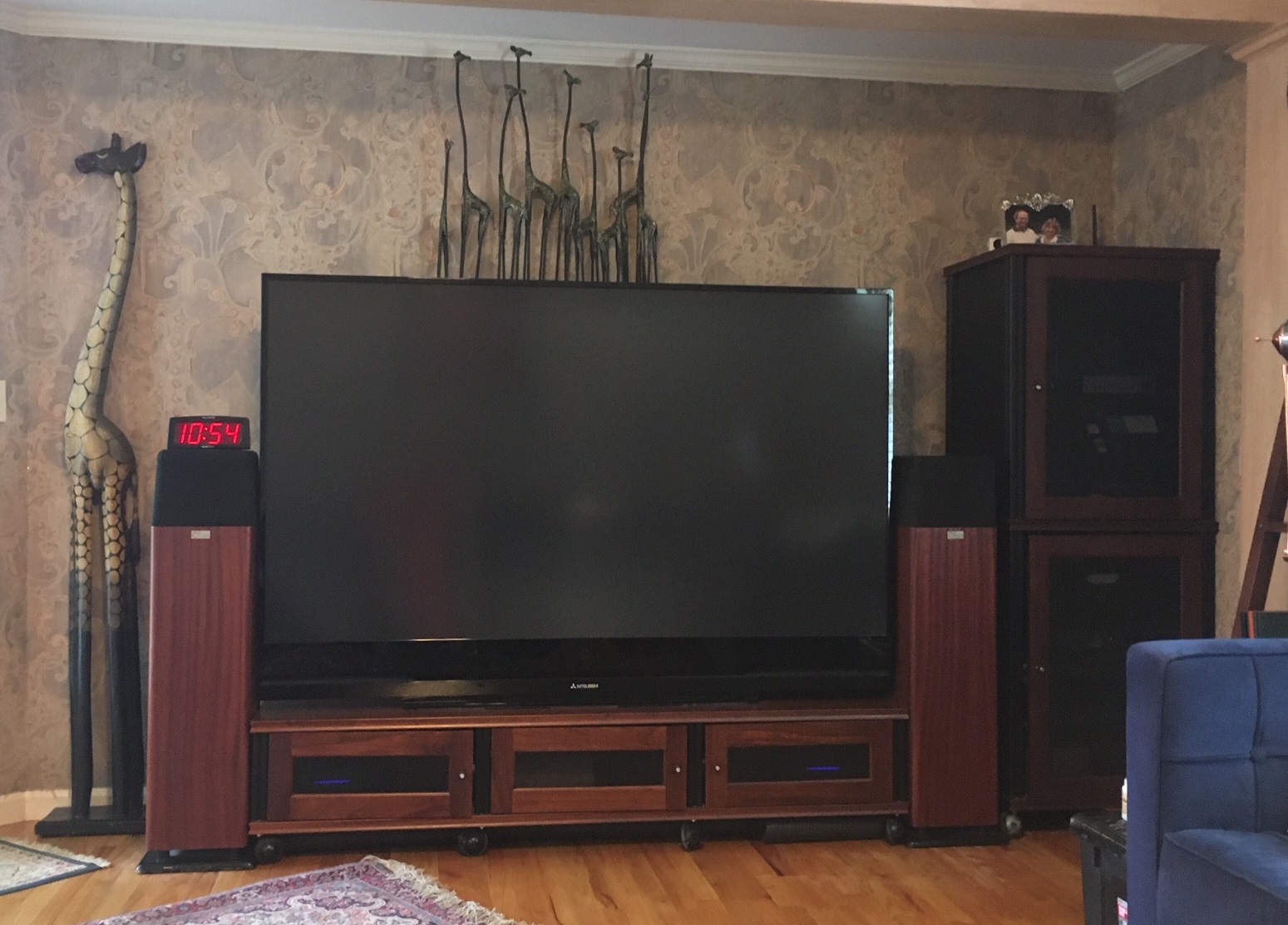
    Both Paula and I like large TVs, although we watch few sports. We purchased our first one when only rear-projection TVs could be large, we kept it for a decade or so. When HD TVs (1080p) became generally available we purchased the largest appropriate for our 14’ room, a 73” Mitsubishi RPTV. We still have it. Each lamp lasts about four years, we have our third lamp in it, and a spare nearby. As we’ve have had that TV 12 years, the spare should be needed soon.

    I think about a new TV every few months when something brings it to mind. With our 12’ viewing distance, our current TV shows us as much resolution as we can see (viewing distance article). So a 4K or higher resolution TV in a similar size wouldn’t show us more; we’d have to go to 95-100” to have a clear difference. But such a large TV might be a problem in the room; we’ll see… Regardless, the advances in color and contrast will make a new TV worthwhile – although we are still happy with our old one. In the meantime, the quality/price ratio of what we will buy continues to drop.

    Speakers

    While surround sound is popular, we don’t want it. For us, it just seems like too much cost and trouble for the improvement in the experience. Perhaps if we watched more movies we would feel differently, but movies are less than 10% of our viewing time. Besides, having only two speakers we are comfortable with better ones.

    A previous set of speakers was designed by a friend. For him, a cardinal principle was to avoid crossovers in the human voice frequency range. He believes that we are most sensitive to this frequency range – this did (and does) seem reasonable to me. As the speakers required separate amplification below and above the 100 Hz crossover I found an old Dynaco stereo tube amp for the higher frequencies. The base speakers were constructed by a friend who is both in pro-audio and a cabinet maker – what a great combination! The speakers sounded as good as I expected. Eventually, however, the difficulties of dealing with the tube preamp and amplifier, combined with Paula’s growing dislike of the way the speakers looked, caused me to move towards simplicity – changing both the speakers and electronics.

    For us, the Ohm Walsh speakers are perfect – we have the 2000’s. It’s the lack of a “sweet spot” that makes them so good for us. With ordinary speakers you need to sit in a particular place for the best sound. Because the Ohm Walsh speakers are omni-directional, they give a good stereo image even if you are outside them. (As Paula is when she’s watching TV in the evenings.) Also, they meet my friend’s no-crossover-in-voice-frequency-range criterion. By the way, these speakers are probably a bit too large for the size of our room. Ohm Speakers say that all of their speakers sound the same, but that each is designed for a particular room size. I purchased one step larger than they recommended. We probably gained little (or nothing) from the extra expense but I wanted to allow their use in larger rooms – which we’ve never done.

    Digital Sound

    After using CDs for a number of years in parallel with vinyl we shifted entirely to CDs. As the number grew, dealing with them became too much trouble so I looked for a way to put them on a hard drive. Our first try with this was an Auraliti PK100 file player. It sounded wonderful, and even better after the company produced a linear power supply. But it suffered from a problem for us: The user interface was a simple iPhone app that was just too flaky for Paula to bear. Eventually, we replaced the PK100 with a Sonos system modified by Wyred 4 Sound, which we still use and are happy with (however, the link is to the current version). While it’s limited to CD-quality, my old ears can’t hear the difference with higher resolution material anyway. Additionally, it can use a Network Attached Storage (NAS) device – which we have for local computer backup.

    Preamplifier

    As I mentioned above, I stayed with Dynaco electronics long after the company disappeared. This was possible because they are kind of a cult – with parts, advice, and improvements readily available – and are much cheaper than equivalent new electronics. Our push for simplicity and a tentative interest in surround sound pushed us towards an audio-visual preamp, the Anthem Statement D2. I had been reading about it for years in a multi-hundred-page forum. It seemed perfect: it sounded good, would correct any room deficiencies, was both flexible and seemed easy to operate. I bought it used and it served us well for a decade. But since we never moved towards surround sound, it fell to a search for even more simplicity combined with a desire to solve our lip sync problems. (Please see my How To Fix A Lip Sync Problem post).

    The D2’s replacement is a Benchmark DAC2 DX. Benchmark’s DAC3 line led to the availability of some refurbished DAC2’s. As I doubted I could tell the difference, I saved some money and bought the older model. I was happy that the DX version was available, as its primary difference (a balanced connection input) allowed me to uniquely assign that button to the TV’s audio – an element of the simplicity I was trying for. Also, that model has dual stereo output buses, with a level adjustment of the secondary one – which we use to feed some ceiling speakers. All in all, a perfect fit for our needs combined with an improvement in the sound.

    Amplifiers

    Our first (and only, so far) move away from Dynaco amplifiers came with a pair of Wyred 4 Sound ST-500 amplifiers to drive the Ohm Walsh 2000 speakers. In addition to adequate power they idle at very low wattage, sound good, and provide a balanced connection to the preamp. This last is necessary to avoid a hum from nearby wiring. Finally, their blue glows below the TV’s blue glows adds to the ambiance of the room at night. However, my trips through Benchmark’s gear as left me lusting for their amplifier. The next couple of years will determine if it stays in my mind. (To me, Benchmark seems some kind of reincarnation of Dynaco – so I doubt I will forget it.)

    Conclusion

    I think of my approach to Stereo and TV as a prime example of my transient enthusiasms – lots of reading and thinking, but very little action. Considering that the above changes occurred over fifty years, there really haven’t been many changes. However, all during this I enjoyed thinking about and discussing audio. It works for me.

    June 28, 2020

  • 1971 BMW 2002

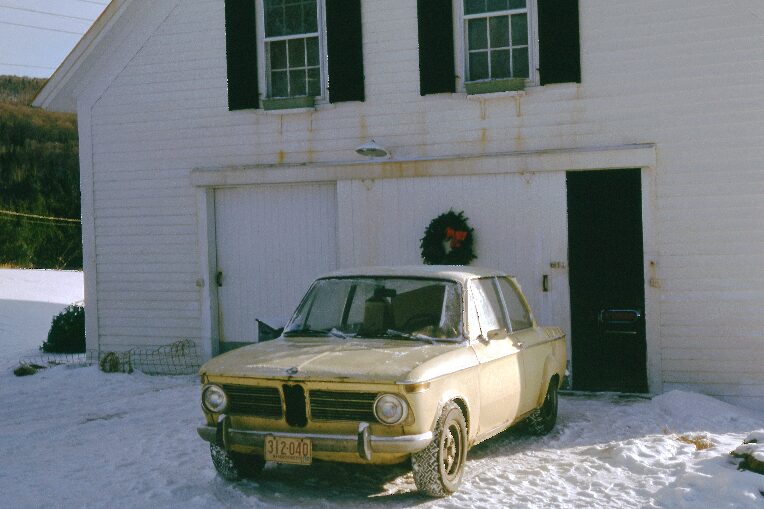
    1971 BMW 2002

    Since my late teens, I’ve read sports car magazines and thought about what I’d like to have. While I was in my last year of college there were many articles about the new BMW 2002. I bought a new 1971 BMW 2002 shortly after I graduated from college.

    I drove it without any changes until it needed new tires, but the new tires shook the entire car. The tire dealer re-balanced them, it still shook. Someone (maybe me, I don’t remember) suggested that we check the runout – it was 0.25 inches. So we checked the rim runout, it too was 0.25 inches. The car had always ridden smoothly, and I figured out what had happened: BMW cut the tires to overall roundness to make sure the car rode well. But either someone never noticed or didn’t care about the out-of-round wheels and the tire-rounding hid them from me until I bought the new tires. The car was out of warranty, and I wasn’t mad enough to fight with BMW about it. I bought new wheels, alloy instead of steel – I’d wanted them, as they were lighter and would reduce the unsprung weight, so I took this as an opportunity.

    The car stayed unmodified until I finished my doctorate at Harvard Business School fifteen years later. During my last year there I thought about what I wanted to do with it; it was worn, of course. I decided to fix it up, but I needed to pay for doing so and I thought of a plan. I created 1040X’s for the last five years with two changes to my original tax filings.

    1. Deducted my doctoral education expenses; there were two tests for being able to do so:
      1. It must maintain or improve existing skills – I had been consulting before, during, and would do so after my doctorate
      2. It couldn’t suit me for a new business or profession – I found professors at MIT and other schools without a doctorate to prove this
    2. Deducted my race car as a business expense; the test was an expectation of profit:
      1. The IRS code didn’t say that the expectation was rational; my partner and I were so naive that we had actually discussed what to do with our profits

    Because they were 1040X’s they were automatically audited, as I knew they would be. The race car deduction turned out to be the easy part; I had to appeal the educational deduction. The appellate level approved the educational deduction. I received several thousand dollars in refunds – enough for the car improvements as I did most of the work myself. These were:

    • Blueprint the engine and transmission, replace the differential with a limited-slip
    • Replace the driver’s seat, replace the front seat belts with racing harnesses
    • Replace the gas tank with a racing fuel cell
    • New wheels, tires, bearings, suspension bushings, and new shock absorbers
    • Weld all body seams for chassis stiffness, repaint, and new windshield

    When I finished the car looked like it just came from the showroom, but was faster and handled much better. It was just what I wanted. The only addition came a year later: a second gas tank in the trunk with a switch to control it – so I could drive between Albany and Washington DC without needing gas, as the 1979 oil crisis could have affected my frequent trips.

    The extra gas tank came in handy for the Cumberford Martinique. On the day the prototype was finished, we wanted to drive it around the parking lot. But we had no gas and no can to put it in. So we used my (mounted higher) extra tank to siphon some down into the Martinique’s gas tank. This earned me one of the early opportunities to drive it sedately around the lot.

    I have two notable memories of my BMW (it’s the only one I’ve owned). First, not long after buying it I was driving from Cleveland to Washington DC, as I did frequently. When I turned South from the Pennsylvania Turnpike I followed another BMW. He went faster and faster, and before long we were around 100 through the mountains. He was a quarter of a mile ahead of me, so I wasn’t concerned with radar – I’d never seen it in that section anyway – and the road was dry with little traffic. Finally, he turned off and I continued at a more sedate pace.

    The second memory is of driving from RPI to Connecticut, to visit my friends, the Cumberfords. A student was riding with me, as I was passing near his home; he thought me strange when I insisted that he fasten all five points of his safety harness. It was night and we were driving down the Taconic State Parkway very fast, between 80 and 90 – and we hit a deer. Afterwards we were both OK, I checked the deer and it was dead. I had the car towed nearby and rented a car. I dropped my student at his home, and drove on to the Cumberfords. There, I noticed that the front of my shoulders were bruised from the shoulder straps. The next day I borrowed a truck and car trailer from them, loaded my rental car, drove to return the rental car, drove to my car and loaded it, drove to Mount Airy, MD, where a friend had a car repair shop. I left my BMW with him, borrowed a car from him and put it on the trailer, drove to the Cumberfords, dropped off the truck and trailer, and drove the borrowed car back to RPI. Later, when my friend had fixed the BMW, I drove down and swapped back.

    I drove the rebuilt car for another ten years. Finally, when it got too tired I gave it to my friend in Mount Airy, MD, who turned it into a race car for SCCA. It’s replacement was a Dodge semi-GLH – without the turbo, but with all of the suspension modifications. It was a worthy replacement; a good-handling sleeper.

    May 15, 2020

  • Growing Up: Age 8-12; Falls Church, VA

    Growing Up: Age 8-12; Falls Church, VA

    We moved to Fall Church from South Carolina (see my Age 5-8; Isle Of Palms, SC post) because my father, a naval officer, was transferred every 2-4 years. While my parents looked for a house we stayed for a couple of months in an apartment on a farm – this was where I first encountered television. As it was the summer and before daylight savings time was thought of, my sister Claire and I were outside with jars looking for fireflys. When we went near the owner’s house, we saw a window flickering and heard strange voices; it was a black and white television playing Kukla, Fran and Ollie, a puppet show. The next day Claire and I asked the owner about it and they invited us in to see it; of course, we told our parents about it and hoped we could get one.

    The house they found was in Falls Church; it had two bedrooms and an undeveloped attic. My father, an engineer, was good with tools and converted the upstairs into a TV room with a bedroom for me beyond it. This gave me a new way of not going to sleep when I should. For years, I’d read under the covers with a flashlight – listening for my parents so I could turn it off and pretend sleep. Now, I found a place in the back of my closet to drill a hole to watch the TV. Unfortunately, when one of my parents checked on me I didn’t have time to return to bed. They filled the hole and I returned to my flashlight.

    Sindbad, a Springer Spaniel

    Sindbad came from a breeder near Falls Church. As he grew, he became very personable and began to explore the world. In the early 1050s he could roam free, which was good as our back yard wasn’t fenced and he wasn’t neutered – few dogs were at the time. He had something on his collar with our phone number; every week or two we would get a phone call in the early evening to come get him from someone’s house – frequently the home of a female dog.

    Like many dogs, Sindbad disliked the mailman; he barked at him and looked like he wanted to bite. However, the mailman had made friends with one of the dogs on his route. When the dog’s owners were out of town the dog stayed with the mailman – and went on the mail route. When Sindbad barked, the dog pushed through the screen door and beat him up in his own living room. That mostly stopped the barking at the mailman.

    After a couple of years we fenced in the backyard. Sindbad, of course, was expected to stay in the yard. But the “springer” part of his breed name was apt; he could easily jump the fence. (We had accidentally trained him to jump by confining him in the kitchen when he was a puppy. The barrier in the door wasn’t high enough, so we gradually increased it.) When he chased a bird – he loved chasing birds – he would run the length of the block, soaring over the fences.

    School was close enough that I could walk, but it was in a different county – which became important. Sindbad tried to follow me to school, so we kept him in the house until I’d been gone a while. No fool, he followed other kids. I’d be sitting in class and suddenly hear his nails clicking in the hallway, then he’d come around the corner and greet me. The teacher would send us to the office, where I’d call my mother to come get him. The “different county” was important because the dog catcher of the school’s county wouldn’t cross the other county to pick him up, and the surrounding county’s dog catcher wouldn’t go on the school grounds. At least we didn’t have to pay for his release every time he found me, and we learned to keep him in the house until all kids had gone to school.

    When we went on a trip without him, he was left at a nearby kennel. He resented this: every time we returned to pick him up he sat in the back seat, looking out the window and grunting his indignation. He ignored us for the rest of the day. As you will see in some future posts, he was a very human dog.

    First Time Camping

    As I was in the Cub Scouts, I read about and dreamed of camping gear – and received a sleeping bag for my birthday. Perhaps partly because of this, my parents decided that we should try camping so we could travel at less cost. We went to some park – I don’t remember where – we had two surplus pup tents, my sleeping bag, and two blankets for four people. Claire had one blanket, my parents shared the other, and I had my sleeping bag. When we went to bed Sindbad got cold and crawled down to the bottom of my sleeping bag – below my feet, as I was short – and curled up. After a while he came up and laid down next to me with just his nose out of the bag, and this is how we spent the rest of the night. (We planned better for later trips. I don’t know how this could have occurred, as my father normally planned perfectly.)

    At breakfast, we discovered that we had bacon, three eggs, and potatoes. My father combined them: he fried the bacon and removed it from the pan; then he fried the cut-up potatoes in the bacon grease; next he poured off the excess grease and added the broken-up bacon and the eggs, and scrambled them all together. We loved it, and it became our standard camping breakfast. (I can taste it as I’m writing this.)

    Decades later, my wife Paula and I went camping with her brother and his wife, their family and friends, and two of our friends. I had told Paula of the standard breakfast and, despite her dislike of grease, she – probably reluctantly – went along with my plans. Our friends had a large (4’ by 2’) gas griddle that they brought along. So I made a gigantic version of the scrambled egg concoction. To her surprise, Paula loved it and our friends loved it too. The others smelled it and came by. They sampled it and brought back more of the ingredients for me to cook. In total, we probably used three dozen eggs, three pounds of bacon, and five pounds of potatoes – and it turned into brunch. That was the only time that Paula and I camped, it was properly memorable.

    Leaving for Guam

    My father’s next assignment was at the shipyard on Guam, which is the far side of the Pacific Ocean – a two week voyage from San Francisco. The Navy sent movers to pack us up, but it was still a lot of work, and they needed more supervision then they received: When we unpacked, we found the moldy remains of breakfast. We planned to drive across the US, camping along the way. As I was packing my books, I decided to leave some for the next kid to use the room. I placed them under the bottom drawer in the chest of drawers my father had built into the eave, and left a note telling where they were. I always wondered if they were appreciated.

    May 15, 2020

  • Growing Up: Age 5-8; Isle Of Palms, SC

    Growing Up: Age 5-8; Isle Of Palms, SC

    The Isle Of Palms is the first place that I really remember and we lived there around 1950. It was connected to the mainland by a single bridge and is near Charleston, SC. My father, who was in the Navy, was stationed at a Naval Base nearby. Our house was the last house on the road to the dump before an undeveloped marshy area, and was just a couple of blocks from the beach. It was elevated enough that my 6’3″ father could easily walk underneath.

    Charleston, SC

    Before we moved to the Isle we lived in Charleston while my parents looked for a house. As both were busy my parents hired a nanny. While Claire and I were at a park with her, another little girl spit on Claire and somehow our nanny was in a fight with her nanny – defending Claire. The fight was intense enough that the police got involved; both nannies were arrested and all of us were taken to the police station. Parents were called and a couple of hours later Claire and I were released. I assume that our nanny was too, as she continued to take care of us for a few more weeks. All of this is hearsay as my only memory of the event is pushing the siren button in the police car.

    Polio

    I had polio just before we moved there, while we were visiting my mother’s parents in Vermont. I was very lucky: there was an iron lung waiting for me in town, but I never needed it. The lasting effects were stuttering, weak ankles, and the muscles that pull my legs forward go out of shape quickly – all minor effects.

    When we moved to South Carolina I was looking forward to being active again. But I was weak – not just the polio – but also from rarely getting out of bed for weeks. So when I was in school I couldn’t go out to play at recess. As I was bored, I decided to sand my desk top smooth – removing the many names and comments. Some of my classmates did the same, but they didn’t have as much time to devote to it. During the first year, I wasn’t strong enough to go the full day. So I’d tell the teacher that I was tired and was going home. I’d begin to walk there, and was picked up by the same nice man every day – years later I learned that he was the truant officer, doing some extra duty.

    Nearby

    As we lived so close to the beach we were there frequently. The swimming helped me become stronger and I became accustomed to the usual undertow; I learned to swim slowly towards the beach and not be concerned as it carried me down the beach. The nearby woods and swamp were a big attraction. We walked all though them and brought treasures home. One was a large chunk of something that I was convinced was a meteorite, I put it in my shirt to carry it and showed it to my parents – who were most concerned with the damage to my shirt. I still wonder if it was a meteorite, and read articles about those found with interest.

    But the dump was the biggest attraction. Naturally, I was forbidden to go there and, naturally, I went. We looked through the piles for treasures and sneaked them home.

    Language

    This was before television and regional accents were stronger than today. My father was from Massachusetts, and had a pronounced accent (think twice JFK’s). The locals couldn’t understand him and he couldn’t understand them. In the family, my mother could translate as she had lived in the South while she was growing up. I presume there was someone at work to translate for him there.

    When I was eight my father was transferred to Washington, DC and we lived in Falls Church, VA. And finally, the somewhat southern accent I’d learned fit right in.

    April 9, 2020; April 24, 2020 added Charleston, SC section

  • Life With Stuttering

    Life With Stuttering

    My stuttering is a result of polio, which I had while in Vermont at age five. We were there for the summer at my grandparents’ house and my father drove up for a few days every few weeks. The house was twenty miles of dirt roads away from the nearest doctor. The family doctor, an osteopath, drove up every day to give me a treatment, trying to keep my muscles working, which was mostly successful.

    As a kid, stuttering was just part of life and I wasn’t really aware of it. When I was seven, my parents noticed me hitting my right thigh with my fist. This was my way of interrupting the stuttering, but it caused a constant bruise. A speech therapist came to the house to work with me every week. She told me to relax when I had trouble saying something, instead of hitting my thigh. While this took me a long time to learn, it was something that my parents could remind me of when they saw me hitting my leg.

    As I was writing this post, I wondered whether I’m an introvert because of the stuttering and whether they are associated. A brief search led to opinions about it, but nothing remotely scientific. My impression is that I would have been an introvert regardless. The introversion made a bigger impact because my father was a naval officer, so we moved every 2-4 years – requiring me to make new friends.

    At School

    There was little effect of my stuttering in school, both the teachers and other students seemed to accept it without comment, until high school. I went to high school in Long Beach, CA – with 4,000 students. We lived in quarters on the base, and the Navy provided a bus to and from school. While I had spent a year in a local junior high, it didn’t feed that high school so the few friends I had made there didn’t help. So I entered the school knowing no one except the few others from the base. The only thing that helped me was that the school was “tracked”, separated into classes by perceived ability. This meant I was generally with the same students. Gym class was the problem.

    Gym class wasn’t tracked, I was in class with kids that were larger, stronger, and more mature. While I’d been active, the polio had left me generally weak – so I was a safe butt for taunting about stuttering, and anything else. Mostly, it didn’t affect me outside of gym class, but one day I was running somewhere and ran through a classroom building. A student from my gym class who enjoyed taunting me tripped me as I entered; I flew halfway across the building and slid the rest – anyway, it felt like that. I got up and continued running, hearing the laughter behind me. I’ve always wondered if that would have occurred without the stuttering. And I still remember the incident with all the intensity of when it happened.

    The only other place that stuttering affected me was when I met a girl I found attractive. Not only did the stuttering make asking her out more difficult, my concern about it frequently kept me from doing so.

    Stuttering When Teaching

    In the first night of my First Teaching Gig the class didn’t go as I’d expected, and my nervousness caused stronger stuttering – which declined when the evening improved. That was the only time I really thought about the stuttering until an event at Rensselaer Polytechnic Institute.

    It was the last class of the course. At the beginning of each class I had a piece of paper that the students could sign, saying they were not prepared. This meant that I wouldn’t call on them for the first third of the class unless they raised their hand. For that class, every person signed the paper! When the class started it became apparent that they had completely prepared for the class, but wanted to talk about other things. So it became a general discussion about life, school, and work. Along the way I asked them how my stuttering affected the class. They said that they noticed it for the first couple of classes, and never noticed it after that. I’m now in my late 70s, I still stutter, and don’t care.

    April 9, 2020

  • Investing In An Inefficient Market

    Twenty-five years ago, after I learned that the stock market had become inefficient, I began to think about investing in an inefficient market.

    Together with a friend who was also an ex-student, I attempted to start an investment management firm. This didn’t work for a variety of reasons, but I used the same analysis I discussed in my Why The Stock Market Is Inefficient and Why Market Efficiency Is Important posts to model an investment strategy. That is the strategy I will present below. How well did it work? It beat the market by more than 4% per year over all periods tested. However, such a test has potential biases and the market may be very different today – so beware! I am not responsible for the results of using the analysis I describe below!

    Caveat: I don’t do investment management – not even for my own funds; someone else does it for me. I do this because it seems best for me; the same “transient enthusiasms” that will populate this blog distract me from managing my investments. Since I doubt that I can manage them well, I don’t do it.

    Steps To An Investment Decision

    Step 1: Find potentially under-priced companies – low P/E companies are a good start.

    Step 2: Use the Fruhan model to find which low P/E companies are actually under-priced.

    Step 3: Evaluate the under-priced companies – apply conventional financial, strategic, and market analysis to determine if the under-priced companies are well-run, effective companies. That is, if you consider them “good”.

    Step 4: Watch the “good” under-priced companies for better-than-market momentum – you are looking for companies whose price is increasing faster than the market. This isn’t simple momentum, which expects the beat-the-market performance to continue because it exists. Your price momentum is biased in your favor by your earlier steps: The logic is: because the company is under-priced, the company is more likely to continue to beat the market until it is over-priced.

    Deciding When To Sell

    Watch the price momentum:

    • If the price momentum falls below the market
      • If the company is fully or over-priced, then you should sell the stock
      • If the company is under-priced, then perhaps you should sell the stock and buy another Step 4 company

    The “perhaps” statement above is the problem. For me, logic doesn’t help with the decision; my preference is to test the strategies with some market data – but I no longer have this. So, basically, my advice here is to “wing it”.

    The Fruhan Model

    The chart below is found on pages 12-13 of William Fruhan’s Financial Strategy book1.

    Here are the steps to use the model:

    1. Estimate the percentage point spread of extraordinary returns (-5, 0, +5, +10, +20)– these are in percent; compare the return on equity to that expected by the market.
    2. Estimate the number of years that extraordinary returns are expected (5, 10, 15, 30)– to address this you need to know why and how those returns were achieved.
    3. Estimate how much of the earnings can be reinvested in the extraordinary returns (0.3, 0.5, 0.7, 1.0, 2.0)– again, this requires that you know how the returns were achieved.
    4. Find the value in the chart; it is the multiple of the company’s book value that the extraordinary returns have justified.

    Note: When I do the above four steps I use the adjustments I recommend in my Book Value And The Cost Of Capital post and I recalculate the return on equity with those adjustments.

    I highly recommend that you obtain and read Fruhan’s Financial Strategy book because it has insights beyond the model and the mathematics that generated the model.

    This approach could also be used with over-priced companies by selling short. However, this is more risky as you could lose your entire investment if the stock price increases enough. Additionally, there is usually a carrying cost for short sales plus you must pay any dividends that the company issues. These combine to limit the potential returns of short selling. Thus, the risk-adjusted returns are less.

    Relating Investment Strategy To Market Efficiency

    Buying under-priced (and selling over-priced) stocks aids market efficiency – it’s effect is weighted by the amount invested. However, the data that I analyzed twenty-five years ago showed that some mis-priced stocks remained mis-priced for decades. This is the reason that we added the momentum requirement before purchase. A single small investor can expect to have no effect on market efficiency. My hope is that this and my other stock market posts generate a broader interest.

    If this approach should become more widespread the returns will occur more quickly. As the market returns to efficiency then the returns will disappear – as the Efficient Market Hypothesis says they should. However, it took more than a decade for the market to become inefficient – so it should also take more than a decade for it to return to efficiency – and it may never do so.

    March 22, 2020

    Footnotes

    1 Fruhan, William E. Jr. (1979). Financial Strategy: Studies in the Creation, Transfer and Destruction of Shareholder Value. Homewood, Illinois: R. D. Irwin. OCLC878176877.

  • Cumberford Martinique

    Cumberford Martinique

    The Cumberford Martinique came from the fertile minds of the Cumberford brothers; Robert was the designer and James handled the business side.

    I became involved through the friend-of-a-friend-of-a-friend. My friend had worked in England when currency export was blocked, so he used his earnings to buy an old Bentley; I volunteered to change its water pump. This was while I was maintaining and developing the software that HBS used to teach financial modeling. “He likes cars and does financial modeling” traveled through the links, and I was asked to visit their company and perhaps do some work for them.

    Of course I dressed up; wearing my best three-piece suit I knocked on the people door next to an overhead door. After a couple of minutes the overhead door rose and a bearded man in dirty jeans leaned under it and asked what he could do for me. I said “I’m looking for James Cumberford”; he said, “That’s me”. I ducked under and was shown around the facility and introduced to some of the people working there.

    The People

    James had been in sales most of his life. He had sold diesel motors for boats, and later owned a yacht delivery service. He had also been a Sloan Fellow at MIT, which is where the friend-of chain started.

    Robert is James’ older brother. He had been a car designer and journalist. His first design job was at General Motors, where he had been Principal Stylist for the 1958 Corvette. He had subsequently designed cars for many other companies, and was widely know and respected in the industry.

    Marilyn was in charge of dealing with the government – navigating the many regulations that affect all car companies.

    Chappy helped Robert produce the drawings for the car. He was the oldest of the group and had started and run a drafting school in Detroit. He once questioned Robert’s statement that the intersection of two services was a straight line – so he spent two days developing the intersection on a series of drawings. (I’ve never seen so many lines on these drawings.) Eventually, he proved it to be a straight line.

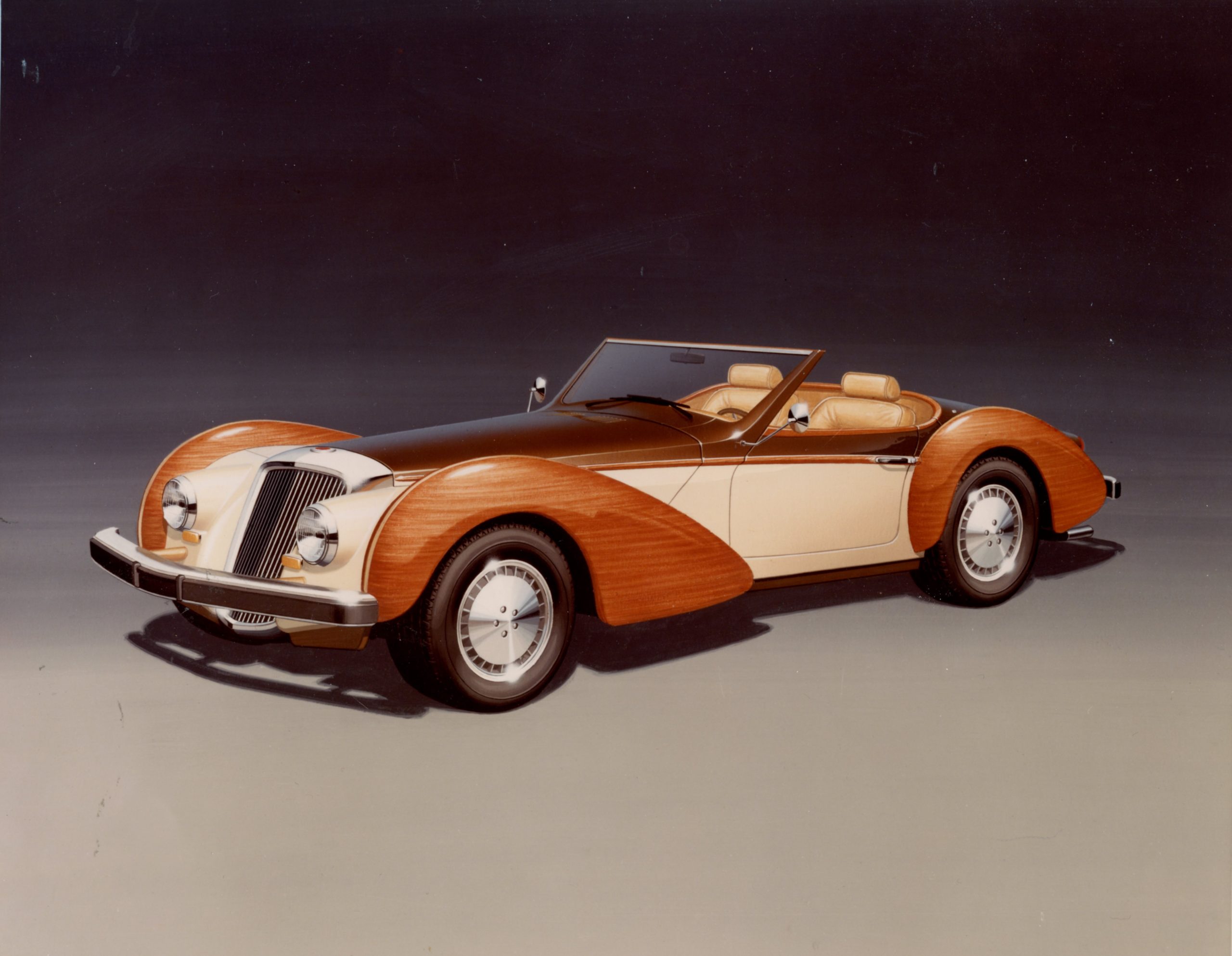
    Peter did everything requiring hands and thinking that didn’t fall into a standard job. He was the one who figured out how to produce the wood-composite fenders that are so distinctive.

    The Car

    At this time old-looking cars were popular – the Clenet is an example – these were a modern version of coachwork on recently-purchased cars with the body removed. While visually striking, their additional weight hurt performance.

    Picture of the Cumberford Martinique at the Detroit Grand Prix before people arrived.
    In Detroit, at the Grand Prix

    The Cumberford brothers had a better idea: They would make a car that looked like a french car of the late 1930s with the best-available technology. Here are some of the highlights of that technology:

    • Engine and transmission from the BMW 733
    • All-hydraulic suspension from the Citroen CX
    • Cast aluminum chassis to the same specs as the F15 by the same caster
      • The pieces were held together by bolts that broke off when they were at the right torque so they couldn’t be over- or under-torqued, very trick!
    • Wheels by North American Rockwell
    • First use of TRX tires by Michelin

    Only Robert Cumberford could have made this possible; no one else in the world would have been permitted to purchase and use these parts. Even he could only do so because the car was to be much more expensive than anything made by BMW or Citroen. The planned retail price was $125,000; this was a lot of money around 1980 when a new Ferrari 308 sold for $45,000.

    The Plan

    It was never intended that there be a lot of these cars; the overall logic came from a statement from someone with decades of experience advertising cars: “You can sell two hundred per year of anything; there are always enough people who want to be the only one at the country club.” So we planned to sell the Martinique for a few years and then produce a car with more modern bodywork. This strategy was designed to avoid conflicting with the suppliers while making fine cars.

    Driveability

    Most of the driving feel of the car came from the chassis and suspension. The chassis was very stiff because of the size of the chassis components and the rigidity of cast aluminum. This is important because it allows the suspension to work as designed. The Citroen hydraulic suspension was made to very close tolerances: the suspension components used needle roller bearings. This, combined with 2.5 turns lock to lock steering left no play at all. So Citroen had designed means of reducing the steering preciseness to the level that the driver preferred.

    Even the springs were unique: They were spheres pressurized with nitrogen; it was that pressure that determined the suspension stiffness. But because they were spheres, they provide an additional adjustment that is very difficult with mechanical suspensions. Normal metal springs have their stiffness increased the same proportion for each spring movement. Translating: if the spring stiffness increases 50% with a displacement from 0 to 1 inch, then 4 to 5 inches will also increase stiffness by 50%. The Citroen suspension wasn’t limited by this: The pressure determined the stiffness of the first inch’s compression, but the diameter of the sphere determined the stiffness of the 4 to 5 inch compression. This allowed a very comfortable ride on smooth roads while stiffening over large bumps. Other cars try to achieve the same effect with rubber bump stops, but it’s not the same.

    Driving The Car

    When I drove the car the first thing I tried out was the self-centering steering. Regardless of what the car was doing, if I let go of the steering wheel it returned to center with the wheels straight ahead– but without tugging on my hands to do so. Then I tried some corners, both bumpy and smooth. It stayed flat and controllable, regardless of how hard I pushed it. The chassis felt like a race car with all body seams welded and a roll cage– because of the stiffness. Just a great car to drive. I also received the first speeding ticket in a Martinique, 80 in a 65 – although I was actually going faster – the officer was kind, and probably intrigued by the car.

    Robert in dark hat, me in light hat, at Detroit Grand Prix to show off the Cumberford Martinique

    What Happened?

    The company had orders (and deposits) for more than one hundred cars. But additional funds were needed to fill the orders. We wrote a prospectus and began the money-raising process. Then John DeLorean was arrested on drug-trafficking (he was later found innocent); all the prospectuses were returned to us within a week. We had thought that DeLorean would go under because, in their first prospectus they had a graph of how many cars that would sell at various prices to justify their forecast unit volume. Later versions of their prospectus kept that volume with much higher prices, and the graph was no longer included. So we were hoping that we could be funded before it happened.

    The Cumberfords tried to continue for a few years, but were never funded. All deposits were returned and all bills that could be paid were paid. Both Robert and James went on to other things.

    April 8, 2020

  • Why The Stock Market Is Inefficient

    Why The Stock Market Is Inefficient

    The stock market is inefficient because the Efficient Market Hypothesis (EMH) is believed. While this sounds peculiar, the EMH may be unique in becoming false because it is believed.

    Virtually anything that you read says that we have an efficient market – but what does that mean? Here’s a definition, the Business Dictionary says: “Market where all pertinent information is available to all participants at the same time, and where prices respond immediately to available information. Stock markets are considered the best examples of efficient markets.”

    That sounds good; but what makes it happen? Here’s the explanation I was taught: If a stock price falls below its “proper” value then investors will purchase that stock and drive its price up until it is properly priced; the converse is true for overvalued stocks. Therefore, stocks are “properly” (efficiently) priced.

    So, the stock market is efficient because investors are looking for mis-priced stocks – that seems reasonable. What do you think would happen if we taught everybody that the market is efficient for fifty years? Do you think investors would still be looking for mis-priced stocks after being told for so long that there are none? I don’t – and the problem is, we have done exactly that.

    So, why does everybody believe the market is efficient?

    The Efficient Market Hypothesis (EMH)

    The logic behind the EMH was first proposed around 1900. It became popular in the 1960s due to Paul Samuelson and Eugene Fama; it became mainstream in the late 1960s by inclusion in the Finance textbooks of the time. Here’s a formal definition from Wikipedia:

    The efficient-market hypothesis (EMH) is a hypothesis in financial economics that states that asset prices reflect all available information. A direct implication is that it is impossible to “beat the market” consistently on a risk-adjusted basis since market prices should only react to new information. Since risk adjustment is central to the EMH, and yet the EMH does not specify a model of risk, the EMH is untestable.1 As a result, research in financial economics since at least the 1990s has focused on market anomalies, that is, deviations from specific models of risk.2

    The EMH is why everybody believes the market is efficient. Note the “H” for “hypothesis”, that’s a formal simile for “I think”. It might be true – but it’s called “untestable” – so it’s just an idea.

    So what does it take for the EMH to be true? The minimum is a large number of investors (or computers) looking for mis-priced stocks. But if the EMH is true, why would they waste their time looking for what never will be found? The only answer I’ve been able to think of is that they don’t believe the EMH – so the EMH implicitly requires that it be disbelieved. I therefore conclude:

    If nobody believes the EMH then it will be true.
    If everybody believes the EMH then it will be false.

    Testing Market Efficiency

    Fama asserted in 1970 that the EMH cannot be tested because the EMH doesn’t provide a method for estimating risk. Regardless, I just can’t believe that so fundamental an idea cannot be tested.

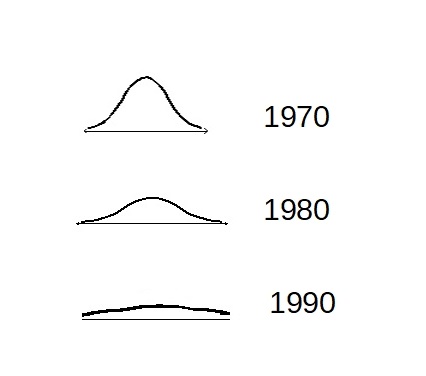
    In the 1990s I thought of an approach: Divide each stock’s market value by a discounted cash flow estimate of its value3; I termed this Market/Model. As I then had access to Compustat data, I calculated this annually for each stock in the NYSE from the late 1960s to the early 1990s. Then, I plotted the frequency of these values for each year and compared the shape of the curves. In 1970 I found a strong central tendency, looking like a normal distribution:

    Typical bell curve (normal distribution), showing expected relationship between Market and Model values for an efficient market.

    by 1980 it had flattened:

    Much flatter bell curve, showing less relationship between Market and Model values, implying that the market is becoming inefficient.

    until, by 1990, the curve appeared almost flat.

    Almost flat bell curve, showing minimal relationship between Market and Model values.

    In an unpublished paper, I interpreted these results to indicate that the EMH has become false – for the reasons discussed above – and that the stock market is no longer efficient. I still believe both the results and the interpretation.

    So, why did I reach that conclusion?

    1. Virtually all financial theories about companies consider the (Model) value of a company to be that of its future cash flows – and I calculated a version of that.
    2. The Market value of a company ought to be similar to the Model value.
      • If they were identical, there would be a single line at 1.
      • Since they are only similar, they should be around 1, so that the plot should show most of the Market/Model values near 1.
    3. Therefore, if the market is efficient the Market/Model should show a strong central tendency – translation: It should show a hump in the middle. It doesn’t, so the market is not efficient.

    Forces Against Market Efficiency

    There have been no forces (or voices) for market efficiency since the EMH was first proposed – simple belief in the EMH has accomplished the opposite.

    • Education
      • Since the late 1960s college business majors and MBAs have been taught the EMH – and have accepted it as true.
      • The Internet is a major source of impromptu education – and teaches the EMH as true.
    • Institutions – mutual funds and retirement funds
      • Stocks held by institutions grew steadily from 5% of the stock market after World War II to 80% today.
      • Institutions choose highly-trained people to manage their portfolios; these people generally believe the EMH and don’t waste their time looking for undervalued stocks.
      • Passive investment management – Index funds began in 1976 and now have more assets than active institutional management – these cannot look for mis-priced stocks.
        • As index funds own the same stocks in the same proportions as the index, they are technically neutral in their effect on market efficiency. However, I consider them a force against because they prevent their investments from being a force for market efficiency.
    • This leaves 20% of the market for individual investors – and they likely know of the EMH.

    Only 60% of the market could support efficiency (half the institutions plus individuals) and the market forces against efficiency have grown steadily since the EMH was proposed. So I believe that market efficiency has declined throughout this period. However, as I no longer have access to Compustat I can’t test it. (To anyone who does have access: I will happily cooperate in repeating and extending my analysis.)

    Miscellaneous thoughts

    There might be subsets of the markets that are efficient because the stocks in these subsets are more closely watched by investors and analysts.

    Why is market efficiency important? See my Why Market Efficiency Is Important post.

    April 5, 2020

    Footnotes

    1 Fama, Eugene (1970). “Efficient Capital Markets: A Review of Theory and Empirical Work”. Journal of Finance. 25 (2): 383. JSTOR 2325486

    2 Schwert, G. William (2003). “Anomalies and market efficiency”. Handbook of the Economics of Finance. doi:10.1016/S1574-0103(03)01024-0.

    3 Fruhan, William E. Jr. (1979). Financial Strategy: Studies in the Creation, Transfer and Destruction of Shareholder Value. Homewood, Illinois: R. D. Irwin. OCLC878176877.