There has been a lot written on what market efficiency is, but much less on why it is important – probably because everybody knows the market is efficient. My view comes from my background in financial markets: Market efficiency is important because it affects the flow of capital in the economy. Ideally, we want capital (money) to go where it gets the best risk-adjusted return. If the market isn’t efficient, it doesn’t go there – and the economy doesn’t perform as well as it could.
Over-
And Under-Priced Companies
In my Why The Stock Market Is Inefficient post I wrote about why I think the market is inefficient. Here I’ll show why that is important to investors and management.
Over- And Under-Priced Companies In An Inefficient Market
Investors do not look for mis-priced stocks, so stocks are not priced efficiently. Investors have poor outcomes and managements have good outcomes.
Under-priced company
Investors can purchase the stock – but the price doesn’t change and they make no profit because nobody else knows it’s under-priced.
Management can buy back stock – this seems to work and arbitragers are probably watching for it.
Over-priced company
Investors can sell the stock, maybe even a short sale – but the price doesn’t change and they make no profit because nobody else knows it’s over-priced.
Management can sell stock – they get more funds than they should; allowing them to hoard cash.
The Result
So what’s left? Randomness and fads! Some companies are considered “good”, and may become over-priced; and others are considered “bad”, and may become under-priced. William Fruhan’s Financial Strategy book1 shows both a tool for assessing stock value and – unfortunately old – examples of management actions when their companies are mis-priced. If it were written today there would be different examples – Apple and Tesla perhaps – but the conclusions would be the same.
Consider the broader effects: When someone is considering starting a company what companies do they emulate? The “good”. When someone is considering investing in an IPO which do they prefer? Again, companies like the “good”. So no capital flows to the “bad” companies; existing ones languish and new ones are neither started nor funded. Too much capital flows to the “good” companies and they don’t know what to do with it – so they hoard cash.
Remember, these “bad” companies are not bad necessarily, they are just not “good”, according to current thinking. But they have fewer opportunities to increase production or introduce new products – and the economy doesn’t have the products that it should have had.
April 5, 2020
Footnotes
1 Fruhan, William E. Jr. (1979). Financial Strategy: Studies in the Creation, Transfer and Destruction of Shareholder Value. Homewood, Illinois: R. D. Irwin. OCLC878176877.
Research on diagrammatic guide signs was part of my first job after college at a consulting firm named Serendipity, Inc. My first task was the same for every project: we called it “getting smart”. It consisted of two steps: (1) Read everything we had that might relate to the project objective; and, (2) write down any thoughts that came while we were reading. The company had learned that those first thoughts almost always contained elements of a solution. We came out of this first task with lists of questions and ideas.
Serendipity, Inc.
Our objectives were simple:
Find which diagrammatic sign designs worked best on Interstate highways
Determine if they would work and where they would work best. Earlier studies showed that most accidents (and most fatal accidents) were in the vicinity of interchanges, with the highest concentrations near major interchanges. So we focused on this.
Our task was to find a way to test guide signs indoors. Our approach was:
Tell the test subject(s) their destination
Project a picture of a road, so they could see how many lanes there were
Project a sign on a screen for a short time, typically a second – based on the thought that drivers were busy near interchanges
Ask the test subject(s) to say what lane they should be in – based on the assumption that last second maneuvers could cause accidents and that early lane positioning was desirable
We moved from asking (for a single subject) to some buttons to be pushed that we recorded, so we could test a group of subjects. This worked, so we received permission from the Smithsonian Institution to use their facilities and access their visitors as test subjects.
Federal Highway Administration
After the project was completed I left Serendipity. After I worked for a few months at another human factors firm, I was hired by the Federal Highway Administration – who was taking over the project and wanted someone who was involved in the earlier work. I was the only junior person, so I was hired.
FHA’s job was to coordinate more comprehensive testing. Their first step was to validate the results. To do so they set up two instrumented cars. These had a small projection screen mounted next to the rear view mirror and a slide projector in the back seat. The testing was similar to the laboratory work:
Tell the test subject their destination
Project a picture of a sign at the appropriate time
Take notes on the car’s movement and the driver’s heart rate
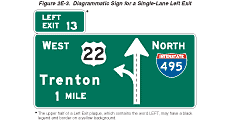
Example of sign projected in the instrumented car
There were three groups of test subjects:
Ordinary people, 25-60
Retired ministers
Airline pilots
Everything went well, and there was only one incident: One of the instrumented cars was loaned to us by Ford; they had instrumented it and used a gold-plated steering wheel to collect heart rate and – for public relations purposes – had used a convertible. That car was following a truck when a chain broke and the truck’s load – pressurized acetylene tanks for welding – began to fall off the back, just in front of the instrumented car. The driver – fortunately an airline pilot – weaved among them and dodged any that would have landed on the car. His heart rate didn’t change while this was going on – only afterwards!
FHWA Testing On The Road
The instrumented car tests indicated that diagrammatic signs had real potential, so we began the final tests: We – the four people at FHA on this project – would set up two test signs and develop methods of data collection and analysis. Simultaneously, an RFP (request for proposal) was sent out to select a firm for a more comprehensive test on the I495 Beltway around Washington, DC.
The two test signs were an issue: we couldn’t find a company that would install them on our schedule as all local companies were booked for months. So we decided to install them ourselves. First, we needed a “before” study. The only approach we could follow on short notice was super-8 video cameras, run at one frame per second. We planned to use four, so we bought six. These were set up on tripods to show the traffic upstream and downstream from each sign. My job was to place the cameras and their operators, and to check back hourly and provide food, drink, and relief. After a few days the first camera broke; I’d already found a local firm to repair it so I took it there and asked them what had happened. They told me that the camera wasn’t really designed to run for long periods at one frame per second; that each camera should be rebuilt every 100 hours to be reliable. Well, that’s why we were doing this; to find out what would happen. I looked at industrial grade cameras, these were much more expensive and couldn’t be rebuilt locally. So we stayed with the consumer grade and planned to buy more.
After finishing the “before” data collection we spent a week installing the new signs ourselves. We rented and put up scaffolding. The new signs were delivered to the sites, stacks of 4×8 plywood, each marked for where it should be installed. We replaced the old signs with the new signs. I’d never worked on scaffolding before, and didn’t like heights. But I got used to it. It took a full week in the hot sun, but we got it done. And we spent another two weeks collecting “after” data.
During the data collection I felt like everything that happened on the few miles where we were working was my responsibility. I drove up and down it dozens of times a day – frequently stopping to deliver food, drink, film, cameras, and people. Any time a car stopped on either side of the highway, I stopped to help. By that time I knew every store and repair stop within miles. Once, it was a truck with two appaloosa in a trailer – beautiful horses. After I helped them they gave me their card and asked me to visit sometime. I’m still sorry I didn’t.
Contractor Testing
This was in the fall; the contract was expected to start early in the next year. They would collect “before” data, change about a dozen signs, and collect “after” data. The sign change was scheduled for the summer months to include as many tourists as possible. The winning company also did something that we couldn’t: they planned to use tape-switches on the highway to measure traffic by lane. They also planned to put some of them on the lines near the interchange that cars were not supposed to cross. All of these were to be connected with wires so that the data could be recorded. While this was much superior to our camera approach, they also planned to operate cameras – primarily for backup. Everything went as they planned and they submitted their final report on schedule.
Results
There were also studies done by eight states; in total, there were about twenty studies of diagrammatic guide signs. From these, there were three major findings1:
More time is required to read, understand and react to diagrammatic signs in comparison with conventional signs with the same number of legends…
Drivers have certain expectancies as they drive along a highway. Because exits are usually to the right … A left exit violates the expectancy of both exiting and through traffic. It is at such exits where unusual maneuvers are required that diagrammatic signs benefit driver
Benefits from diagrammatic signing … In other words, because drivers decide earlier on the appropriate path to reach their destination and position themselves accordingly, there is less indecision at the gore proper [where the roads split].
Several years after the final report, there was a study of accidents and fatalities at the changed interchanges. These found a 20% reduction in both at the recommended locations for diagrammatic signs: left exits from Interstate highways. Overall, this was an unusual research project because it encompassed multiple sign testing methods ranging from the laboratory, through instrumented cars, on-highway, and before/after accident and fatality records. While my part was small, it provided a standard that I have remembered.
April 3, 2020
1 Pages 4-6, Diagrammatic Guide Signs For Use On Controlled Access Highways, Report No. FHWA-RD-73-21, December, 1972.
While I was working on my doctorate at Harvard Business School I took a one semester job teaching a graduate finance course one evening a week at Babson College, a business-only undergraduate and graduate college in Wellesley. This is the story of the first night of the course.
The course began in January; I had prepared carefully – I thought – as I wanted to make a good first impression. (As Babson was unofficially associated with HBS, having many of its graduates as faculty, teaching ratings were important.) I had assigned a case in the class notes, but no one had even read it.
Note: A case in this context is a description of a situation in an organization that requires a decision. Its length can range from a single page to thirty or more. A finance case includes financial data, which requires analysis – generally arithmetic and thinking. The case I had assigned was probably about a dozen pages. My plan was to use elements of the decision for very short lectures on finance.
I tried to turn the session into a lecture, based on the case and my short lecture planning, asking the class to take ten minutes to read it. My problem was that I hadn’t considered that I might have to do this, so I did it poorly. I stumbled through it until the break, it was a three hour class with a fifteen minute break in the middle. The break finally arrived and I walked outside to think.
“What to do” was my problem. I wanted to get in my car and drive home, but I knew I couldn’t do it. So I had to go back in. I thought about the material that the class would need to know to analyze the cases for the following week. Normally, the assumption for a case is that the student would do the needed reading in order to analyze the case. But I decided that a lecture on it was the only thing I could do that might regain some ground with the class. But I had to tell them what I thought was going on, so that they could understand why I was doing what I was.
The first thing that I did was to apologize. I told them that this was my first course to teach, and that I hadn’t considered what I would do if they hadn’t gotten my request to prepare the case. I felt that this explained the situation without any hint of me blaming them, which I felt was important to get them working with me. Then I told them I was planning to lecture for the remainder of the evening on the material for the next week and asked their help in putting an outline on the board. They did help, expanding some of the points. And the lecture seemed to go well.
At the end of the evening I described the decisions needed in the cases for the next week, and how the things I’d lectured on might relate to them. Finally, I told them I was looking forward to the next week and I hoped that they were too. I was very happy to find that most were there the following week.
I learned a lot from this experience. I feel that I dealt well with a bad situation by: first, admitting that it existed; and, second, by getting others involved in fixing it. Then, I learned that I should avoid that particular situation by better planning for the first class: never again did I assume that material was read – far less, prepared – for a first class, not even by graduate students.